Click for Computer Generated Transcript
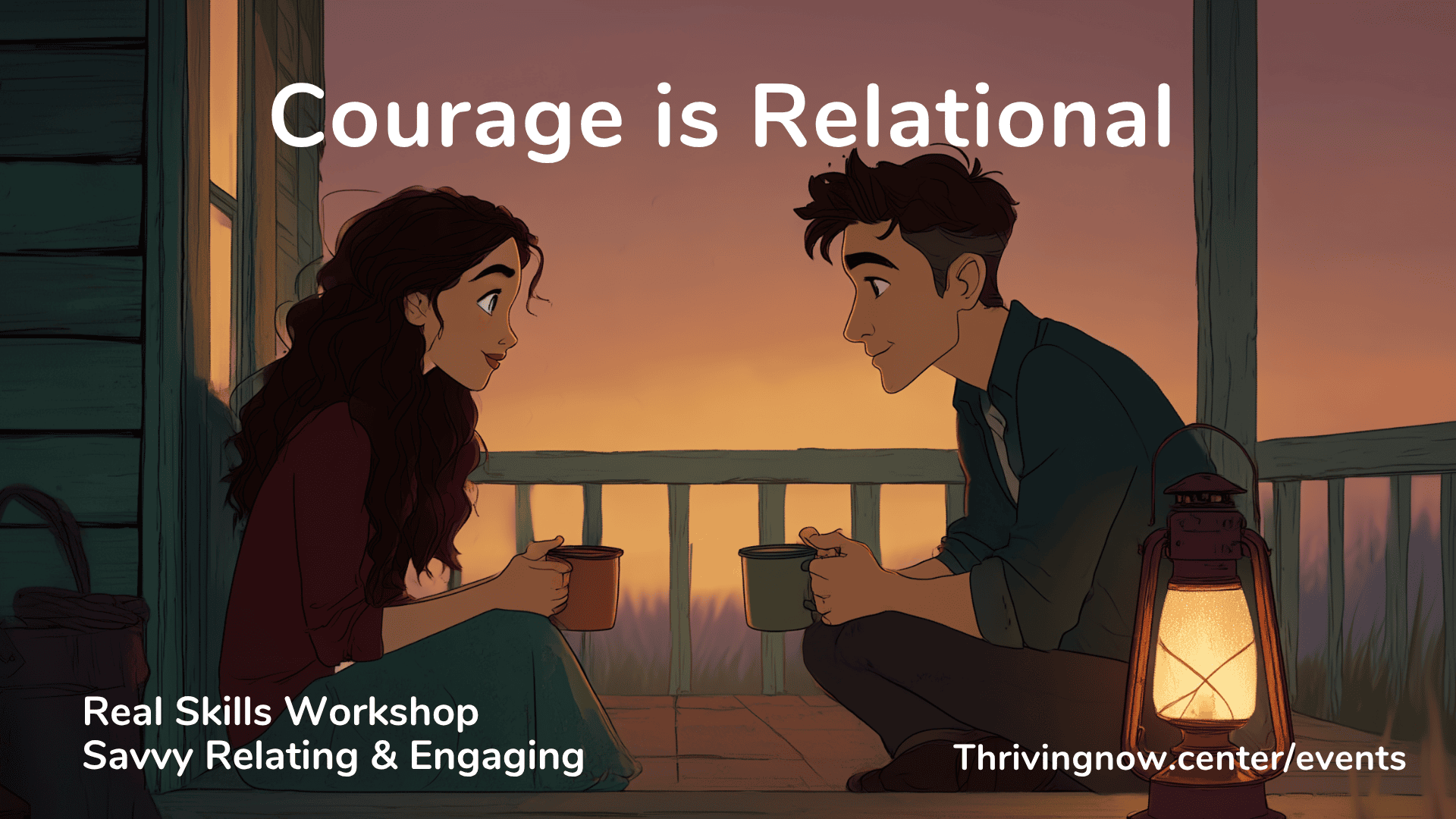
Courage is Relational
[00:00:00] Courage is relational, a real skills workshop. I’m Rick from ThrivingNow, and Cathy and I are here , to explore this with you. And please know that even if you’re engaging with us months from now, that uh, our inbox is open at support at ThrivingNow dot com, you can leave comments in the the ThrivingNow Center because courage is something that I find is profoundly misunderstood and that it’s not something that people own for as much courage as they show in their life.
[00:00:33] Can, can you help us understand what courage is from our. Thriving viewpoint. Yeah. I think a lot of people con they put courage and bravery this in the same bucket, and I don’t think they’re really the same thing. I think if we think of a brave soldier, it’s like I gear myself up, I use my willpower, and I ha ha ha ha.
[00:00:53] I’m really excited and I’ll push myself through it. Uh, like I’m not really facing the fear or my doubts. I’m kind of like revving up and going on adrenaline and trying to get through the thing. And maybe I, I’m, I’m facing danger, but I’m not really letting myself be as present with it. To me, courage is being afraid and doing it anyway, which means.
[00:01:14] Facing, sometimes it’s just facing the fact that I’m scared, facing what I’m scared of, what are the stories I’m telling myself, being present with what could happen or what I fear could happen, and kind of going, is this real or is this just a mex memory from when I was a kid? Or a projection or a conflation?
[00:01:32] But for me, it’s a lot about slowing down and rather than rushing ahead, bravery to me is like I’m rushing ahead really fast to get through it. Courage is, I’m like, oh, can I be with the, be with myself as I walk through this thing? Or, you know, choose what parts of this idea. It’s much more thoughtful and introspective to me.
[00:01:53] And I’d love Rick for you to share, but if you’re in the chat, if, and you’re in this call, what does courage mean to you? I’d love to hear, like, if you wanna just put it in the chat.
[00:02:04] See, I, I have a, a broad sense of. Courage as that energy that has people showing up and being present. Mm-hmm. So, for example, I feel the contrast between the people that are choosing to engage around courage, being in relationship, and that there’s, there’s a tank of courage and we’re not, we’re not totally law, um, without courage.
[00:02:37] And we also, it ebbs and flows and it varies depending on the we space that we’re a part of. Yeah. Now someone said courage that feel the fear and do it anyway. And as I explored this. Philosopher using AI explored this with philosophers going back thousands of years, and many of them differentiated between bravery and courage.
[00:03:05] Mm-hmm. That bravery has a bias toward do it anyway. Mm-hmm. And that’s sort of a, a, a brave act. A heroic act. I felt the fear and did it anyway. Yeah. Um, a courage doesn’t necessarily have performance to it. You know, a lot of our myths and things have a performative quality to it. Heroic. He did a heroic act.
[00:03:34] Mm-hmm. Now, the person that holds the hand of their dying friend week after week after week after week after week. Quietly present. Mm-hmm. No, does not like hospitals. This is not where they want to be. Um, there’s a, a courage there in their state of being. And in the same way, the people that show up and hold space for what we’re talking about, for how courage has played and not played in their life.
[00:04:13] Um, and even having the desire for more courage around things that matter to us, to me, asks courage. There there are many thousands of people that bounced off of this. Mm-hmm. Now, for some it’s just not interesting to them. Maybe they, they really understand courage for themselves and it’s not a, a question, but I know in the work, having done this work for a long time with Cathy, that um, I can feel.
[00:04:44] Hundreds of people out of the thousands on that were invited to this. Really, literally thousands of people were invited to this who say they want to be thriving. And we’re saying as people with a lot of experience, that courage is one of the keys to a thriving life. Yeah. And they bounced off of it. Yeah.
[00:05:09] And it’s okay. Like that’s, that’s part of what we’re doing. Those that are ripe and ready and, and wanting this are saying, yeah, courage. Let me explore this with you guys. Is this something that I can feel inside myself? Can I acknowledge the ways that I’m courageous and the circumstances that bring that forward?
[00:05:33] Can I, can I acknowledge and accept that, you know, some people in some relationships, um, the courage is gonna be kind of like. Just showing up, but not necessarily courage to speak or courage to act because your energy and your wisdom and your savvy says mm-hmm. Not here, not here. And there is a quality of upright qi like stepping into your power if you start with it as a state of being like, well, do I feel powerful here?
[00:06:10] So a little exercise for me, and I share it with you guys as I do it. Um, how present am I with this as a challenge, Jing topic, courage.
[00:06:27] And if I allow myself to settle more into being here now, not having to do,
[00:06:38] even though there’s doing, I’m, I’m co-creating this workshop with all of you. I’m on camera right now. And yet courage that I feel is not a heady thing. It settles in and strengthens. So the sensation, and it’s a powerful one of settling in to being here now and strengthening the quality of your presence.
[00:07:09] Courage does have a quality of, of heart to it. Mm-hmm. Um, in fact, uh, going back thousands of years, it’s root in Latin is around the heart and it’s, um, it became the word courage later. Uh, so is there a power? Yeah, there’s an energy. To me when power, power means that I’m feeling my life force and I have access to it.
[00:07:38] Yeah. It’s, it’s not, um, I. At times when I’ve been brave, I feel like I was taken over in a good way, in a way that was congruent with who I want to be. I, I get up, I race to the water, I dive in, I save the three-year-old. Mm-hmm. Okay. My life wasn’t at risk in that case, but it’s kind of a classic heroic thing.
[00:08:15] Um, courage. You’re aware of a different kind of dynamic, like it’s take, it’s, it’s, it’s activating you. So innate power would be activation energy to be present and solid and strong, um, or shaky and present and devoted. There’s a number of different flavors of courage as it expresses itself in our physical body and in our actions that come from that.
[00:08:50] Um, but it’s certainly not a flacid feeling like it’s, uh, it has life force to it. Yeah, I agree. I’d like to go back to like, I, I, I love what you’ve shared and I also think it’s useful to kind of dispel some myths about courage, at least ones that I’ve heard from a lot of people. And I also believed, like growing up it was kind of like, oh, that person is courageous.
[00:09:19] That person isn’t, it’s like you have a certain, it, it was like born into you and you are either a courageous person or you’re not, which I think we talk about a lot. Courage is a muscle we can build and, um. I think I never, I, it’s more recently that I’ve been looking at how courage is relational. It’s relational to the situation I’m in, how supported I am.
[00:09:42] The connection I’m in, in the moment. I kind of thought, oh, I can build the muscles and I can, like, I think, um, medical science is very much like, oh, if you can lift 30 pound bicep curls, and that’s how strong you are and that’s how strong you should be every day. Versus like, oh, if I haven’t had enough sleep and I’m really hungry and or I worked out really hard yesterday or whatever, I’m not gonna be able to do that bicep curl as well.
[00:10:07] Um, so my, my courage, muscle strength can ebb and flow too. It’s like, you know, if I’m hanging out with Rick and we feel really connected, I’m much more courageous. And I’ve in fact asked him sometimes to help me with things that I just, like, I haven’t got this thing done forever. Can you just hang out with me to help, you know, I feel more confident.
[00:10:26] My nervous system feels more settled, can, you know, to get this thing done. And I really, I was, as I’ve been watching that, I’ve been really surprised to watch how much it shifts. I think until I was, until I, someone brought that my, someone I really trust and shared that courage is relational. And I was like, whoa, wait a minute.
[00:10:45] What? Let’s talk about that. What do you mean? Um, and I, since then I’ve been paying attention to it and I think I would often use. Um, this concept of courage being a fixed amount is a way to beat myself up. Mm-hmm. Oh, I was that courageous yesterday. I should always be that courageous. Why am I not that courageous today?
[00:11:06] And it, it ebbs and flows just like our strength of lifting something or running fast or, you know, the courage to show up and be present with someone. Those are, those things can ebb and flow. And I think once we’re aware of what helps our courage ebb and flow, we can do things to consciously tend to our courage bucket as you talk about.
[00:11:26] Um, and help, help our, help us step into things we, we want to get done. And also know, like maybe today is not the day to do that.
[00:11:45] There is a quality and it’s one of the reasons why I chose this work is. I’m around courageous people. Mm-hmm. In my private sessions, in my group sessions. Yeah. In these workshops. Mm-hmm. And in people that choose to share what’s alive and real for them. And like I, I hinted to before, but I’ll, I’ll say again explicitly, if someone is in their courage, it is rare that if I point that out that they would say, oh yeah, I feel courageous.
[00:12:30] Oh yeah. Most of us don’t recognize it. I think in the moment it’s, um, and yet it’s palpable, especially for those that are sensitive, that want to live in a world where. Um, there’s, there’s more hardiness than, um, knight in shining. I, I would love to live in a world where no knights in shining armor are needed unless they want to, you know, do a little sparkle dance in the sunshine in their shiny armor.
[00:12:59] Um, I, I really would love a world, but that doesn’t change. That courage will be like holding space for someone’s yearning and the sharp edges of their yearning, or we’re longing and someone expressing their longing. To me, there’s, there’s tremendous courage in revealing to anyone or even your journal sometimes, um-ing it ourselves.
[00:13:29] Have to help where your, yeah. Where your un unmet yearnings and longings and, and, um.
[00:13:40] So courage is a vibration that we don’t necessarily, um, feel it as, as courage when we’re in it. Mm-hmm. Just to let you know, that’s why I, I have used and we’ve, we’ve taught workshops around feeling calm and confident. If you are calm and confident, you’re radiating an energy that has your heart in it too.
[00:14:04] And there’s a quality of being able to be with reality and in relationship. And, um, if you’re settling and strengthening yourself, however imperfectly, you’re still radiating what I pick up on as courage. Mm-hmm. Uh, that’s different from someone who’s dysregulated and crying for help doesn’t make them wrong.
[00:14:36] But that’s different than the person who’s dysregulating and looking in. Are there any, is there anyone around here that I can co-regulate with and build, build back my sense of calm, build back my sense of confidence, um, and courage? Uh, that, well, it just, it’s a different bit of a different vibration and that’s part of the skill is you can start picking up more and more.
[00:15:02] In retrospect, I find at the end of the day, if you’re looking at yourself is that was any point during the day that I did, I was courageous in a courageous place, ex and being that, um, go ahead. It just one of the thoughts that when you were talking about that, like I, that’s a very different energy than feeling like courage, calm and confident is definitely very different than this.
[00:15:29] Kind of like, oh, someone saved me. But I do also think asking for help can also be courageous. It’s kind of situational as well. Yeah. Like, is it, am I, am I defaulting to asking for help all the time, or am I, oh wow, I, this is something I, it would really be good for me to have help with, and it’s actually a little hard for me to do it, so I’m gonna, but I’m gonna try to do that and try to reach out.
[00:15:52] So I just Absolutely. I just wanted to, I, I don’t think it’s what you meant, but I wanted to clarify that because I think sometimes asking for help is a very powerful thing. I would say that most of the courage that I demonstrated is, is asking for help, reflection, support, and that get active. You know, a lot of the courage I experience in this work is people having the courage to be present with what they’re feeling.
[00:16:20] Regardless of how, I mean often intensely painful things, and yet sharing and opening up in that. And that, that to me also fits. Uh, someone said, you know, is it a spontaneous conscious act? Um, I, again, I, I’m choosing to start with a differentiation between ACT and, um, spontaneous acts tend to fall into my category of bravery.
[00:16:53] But, um, I think what this person has taught, I asked them, can you say some more? Oh, okay. And they said, in my experience, sometimes a friend or relative is expressing a certain need and I’m responding quickly, offering help, assistance, commitment. And I would suspect that’s generosity, not courage. It may take courage to do it, to offer that, but I think that the generosity is, is.
[00:17:15] Maybe that’s very, um, we have neural pathways. What we practice is easier for us, our go-to moves, and it may be that you have a lot of generosity and your go-to move is to help to jump in and try to offer help. Um, and it may be, it may feel frightening sometimes, but your neural pathways are, well, you have a lot of practice.
[00:17:34] That muscle is, flows easily and as strong. And I would guess it’s a generosity that’s flowing spontaneously for you. Um, for me at least my personal experience, I often will have to slow down and take a breath and say, hold on. I need to gather my courage. I need to, and sometimes it, I can just, I’ve practiced it or it’s really important to me and I will go there, but.
[00:17:57] Mostly it’s not spontaneous for me. It’s a, it’s a, okay, this is gonna be a little hard and I’m going to, you know, how can I best tend to myself and my, and my, how can I gather my courage? What do I need? It’s very, very silly and I’m embarrassed to say it, but, um, I have one Y is a, a Buddhist, it, there’s, she’s in many, um, different, uh, spiritual, uh, practices, but Guian is the goddess of compassion.
[00:18:26] And she, she was, uh, the story is that she became so enlightened that they, they offered, she was allowed to go to heaven and she said, no, I’m gonna stay here and hear the cries of people that need help the suffering and try to help them. Well, I have the statue of one in and. There are times when I either touch it to help me feel more creative, and I actually hold it and I’m like, okay, this is gonna be hard.
[00:18:48] I, but it helps me feel supported and connected. So that helps me gather my courage to face things that are pretty scary. So like, it might be I call Rick, or, you know, I, I say, please send me a picture of Adera. 'cause I need some kind of feeling connection. But it’s, for me, it’s not spontaneous. I don’t feel spontaneously courageous very often, and everybody’s experience is a little different.
[00:19:12] We don’t get to tell you what you are feeling, um, but just questioning whether it’s your generosity that’s spontaneous versus your courage. Mm-hmm. Yeah. We’re not, we’re not the feeling police, uh, just as, as Cathy clarified, if it feels courageous to you, then it’s, um, uh, regardless of whether it rises, um, spontaneously, um.
[00:19:40] My, one of our core points that we want for all of us to recognize is we’re, we’re probably in our courage more than we would proclaim. Mm-hmm. Um, perhaps, uh, more than we would feel comfortable even acknowledging like how much courage it takes to speak, um, to speak a truth to someone who has, um, some power over us, like in the medical field.
[00:20:12] Um, could we do some tapping on that? Just, I think it’s, yeah. Would you need? Yeah. Yeah. I invite you to take a nice, gentle, deep breath as we talked about. Courage is relational. The more we can practice being with ourselves, connecting with ourselves in the moment, I think that’s a way to connect and feel that courage more.
[00:20:32] And I invite you as you tap, just to notice your but in the seat and notice how your fingers feel as you tap on your skin. Karate Chop:, even though I don’t think I have very much courage, even though I don’t think I have very much courage sometimes, and I judge myself for that and I can judge myself for that, I should on myself.
[00:20:55] And I should on myself. I should have done that. I should have done that. I should have been more courageous. I should have been more courageous. No one really gave me an operator’s manual. Nobody really gave me an operator’s manual. Top of the Head:. Maybe I’m more courageous than I think. Maybe I’m more courageous than I think Eyebrow:.
[00:21:16] No, that’s not possible. That’s not possible Side of the Eye:. I’m afraid all the time.
[00:21:26] I’m afraid all the time Under the Eye:. But maybe that’s a sign of my courage. But maybe that is a sign of my courage. Under the Nose:, I’m turning towards things that make me afraid. I’m turning toward things that I’m afraid of. Chin: and trying to face them and trying to face them. Collarbone:, courage may not feel how I think it feels.
[00:21:51] Courage may not feel how I was taught that it’s supposed to feel and look under. Under the Arm:, there’s no cape with flow blowing wind flapping. I have no cape with blowing wind. No heroic pictures, no heroic pictures. Top of that, it’s quiet presence. It’s quiet presence. And I think I might be doing that more than I realize, and I think I might be doing that more than I realize.
[00:22:23] And I just invite you to take a deep breath. Just try that on. You don’t, again, we’re always, we offer ideas and thoughts and you can try them on and see if they elicit something. And my, my hope is always that what we share is very helpful to you. Whether it’s that’s amazing and I like that, or Oh, never that I, that’s not true for me.
[00:22:45] It just, it’s a way of shining light and helping me see yourself better. So. Well, there’s an interesting, and, and one of the reasons that Cathy and I touch on so many different aspects in a couple of tapping rounds is that we’re inviting you to try on certain things and just see what rises. Um, I’m quite aware that if I.
[00:23:13] If you said, Rick, are, are you courageous? My first response would be, no, not really. Not more than your average bear. Yeah. Now why I, what came up in that tapping around is something that I really hadn’t considered. Well, courageous people have to dot. Oh, I was like, oh dear.
[00:23:42] Oh dear. Um, so this is something that we can also tap on and, and it’s worthy, I think, of taking a moment to say, well, if, if I was courageous, I’d have to, what, what do you, uh, what comes up for you? Hmm. Yeah, I think that’s a really good question. If I was courageous, I would have to, and that alone, there could be some reversal there.
[00:24:13] If I was courageous, I’d have to like, you know, be really out there and I’d have to like, fight everybody that was bad and do all these things and my nervous system. Like, no, that’s not I wanna do. So therefore I cannot be courageous. Yeah. Even though I reject being courageous. Now this is, we’re gonna use a little gameplay here with energy, right?
[00:24:36] Uh, even though I reject being courageous, even though I reject being courageous, especially if it means I have to do all those things, especially if it means I have to do all those things. In order to to be true to my identity, in order to be true to my identity. Courageous one. The courageous one, Top of the Head:.
[00:24:57] Fuck that, fuck that. Ira. Don’t call me courageous. Don’t call me courageous Side of the Eye:. That comes with a lot of burden. That comes with a lot of burden Under the Eye:. That comes with grotesque expectations. That comes with grotesque expectations Under the Nose:. I don’t want to face all my fears. I don’t wanna face all my fears.
[00:25:22] Chin:. Some are really reasonable. Some are really reasonable. Callone. I’m afraid of certain people. I’m afraid of certain people, and that feels really wise. That feels really wise.
[00:25:39] Don’t call me courageous if it means I have to. Don’t call me courageous if it means I have to. I want to. I want the freedom to be courageous when it’s in my thriving interest. I wanna be courage, feel the freedom to be courageous when it’s in my thriving interest, and to have healthy boundaries when it isn’t, and to have healthy boundaries when it isn’t.
[00:26:05] I would actually argue that having healthy boundaries is courageous in itself. But you don’t have to. No.
[00:26:15] So, so, so notice what this is, part of the real skill is as we explore something, you may, you may realize, well, oh, okay. So Rick and Cathy are talking about things and as I look at my life, I’m definitely showing that I’ve been courageous. I’m, I’m showing up here, I’m doing this work together. I’m tapping on some uncomfortable things.
[00:26:36] Um, and, uh, please don’t call me courageous because if you do, if that lands in my identity, I am courageous. I, I’m courageous. And this is, this is maybe part of the jujitsu of what we’re talking about with this energy of courage. It’s relational more than identity. It’s an energy that we can call on, that we can embody, that we can be in, and it’s going to fluctuate.
[00:27:10] As Cathy said, it can fluctuate just because our organism is tired. Or, you know, I, I used up my courage tank in the last three days, and right now I just wanna hide under the pillow and replenish myself. Um, but also part of the relational aspect is, um,
[00:27:39] am I free to say no? Yeah. So I do believe that there’s, there’s a courage in saying no. Um, that, that is to me often a, a courageous act, just like saying yes. Is also a courageous act at times. Um, saying, tell me more. I’m not, I’m not sure It can be a courageous response, but there are people where that dance I is just so unpleasant.
[00:28:20] Okay. When I say I’m scared of people, there’s also like, I’m repulsed by people who, if they want to do something, use all of their life force, their charm, the, the peer pressure and everything else to get compliance. Yeah. Okay. So it, when I think of courage as relational, am I lacking courage by not going to the party where there’s a predominant energy of peer pressure to do things that are not a yes for others.
[00:28:56] I don’t want to feel other people being pressured because that would have to draw on my courage to say, look, I’m not picking up that, that’s a yes for them, buddy. So back off. Now you notice there’s a quality of energy of, of I’m having to, I’m consent matters to me so much that if I’m, if I’m going into a non-consensual dynamic that I, I know of, um, I have a problem.
[00:29:23] If I use my courage to go, well now, I’m gonna need a lot more courage to navigate that for myself, for, um, uh, other people that might be with me. So you see, for me, there’s a quality of, of, um, preciousness Yeah. To courage. And I,
[00:29:51] I want to be a, a mindful steward of. Where my courage is called forth.
[00:30:02] And part of that relational thing is, well, what, what makes this relationship, this space, this experience, something that is worthy of me showing up with courage? What makes it matter to me? And if you can’t answer that, this is what I, I would start tapping and said, I’m not sure why this matters to me. I’m not sure why this matters to me, Eyebrow:, it would take courage to go.
[00:30:27] It would take courage to go Side of the Eye:. It would take courage to do it. It would take courage to do it Under the Eye:. And I’m not clear whether it actually matters to me and I’m not clear whether it actually matters to me. Do I have enough courage to determine whether it matters to me? Do I have enough courage to determine whether it matters to me and with the freedom not to do it anyway and have the freedom to do it, not do it anyway?
[00:30:54] I really like being free. I really like being free.
[00:31:01] And sometimes it takes courage to have clarity and sometimes it does take courage to have clarity, Top of the Head: and some experiences and people are too expensive, courage wise, some experiences and people are too expensive to have courage around. And, and that’s up for me to choose and that is up for me to choose.
[00:31:26] Now we, we, sometimes we feel obligated and that’s a different, that’s a different workshop. We’ve done work on obligation. If sometimes it takes courage to do something and show up to fulfill an obligation, um, knowing that, you know, that’s where you are. Um, but like as that was useful for me. 'cause as you were tapping, I get clarity that if I had infinite courage.
[00:31:52] I wouldn’t, I use, I often say, oh, I’m too scared to do that. That’s my way of like, oh, I’m gonna put a limit on it. Um, and I think my thing is, can I be with reality and say, oh, am I, am I scared of, is this a no for me or is it an old fear? Is it, or is it a real fear now? Um, can I be clear on all the different moving components before I decide?
[00:32:17] Versus if I had infinite courage, I should do all the things that I think I should do. And that’s just too much for any human being like, yeah. I use my fear as a limiter for myself, and if I’m infinitely courageous, I should do them all. And that’s just, oh, I, that’s too much. I don’t wanna do that. But I do think being with reality and looking at where is it difficult but true, like it’s true.
[00:32:43] I’m going to a workshop, uh, a conference next week, and my knee has been bothering me. And I really, really do not want to rent a scooter, but I am going to rent a scooter. I have, it’s taking a lot of courage to do that, to face reality that it’s a lot of walking on cement. It’s standing in place all day, like it’s long, 12 hour days on cement, walking around all day, no place to sit.
[00:33:04] I can’t do it. My knee will not do it. So, you know, I kind of tried to negotiate with reality for a while. Maybe it’ll be okay, I’ll take my walking stick, maybe I can find some, no, this is not gonna work. We’re at the skater. But it’s taking courage to look at that, to determine, you know, part of me is like, oh, maybe I can, I shouldn’t go to the conference, but I really do wanna go to the conference and it’s something that’s important for my career and what I’ve con contributed to and I see people I really care about and knowledge.
[00:33:33] Um, but I had to look at the reality of it. And that took courage. And then calling to like, I’ve never rented a scooter before. How do I know how to navigate it? How do I know how to handle it in the rooms and stuff? It’s taking a lot of courage to do that. Um. So I had to slow down and just be with it for a little bit and kind of pick it apart and like, I don’t know about you, but I tend to lump like all kinds of things all together and like, ah, it’s too much.
[00:33:59] And it’s like, no, here’s this aspect of it. What am I feeling about that? Okay. That’s just an old fear. Like it’s, I, I want people to think that I’m cool and riding a scooter doesn’t feel cool, cool to me. Um, or confident, that sort of thing. Where, where have I. Projected, um, stories about things or like my pride getting in the way, so to speak, versus, you know, what is reality and what is useful and true in the moment.
[00:34:27] So kind of picking that apart has been an exercise in courage just by looking at it and not trying to deny, oh no, I’ll be fine. I’ll get there and I’ll just tough it out. I’m like, eh, I don’t think this is a tough it out situation. Um, and then facing like, oh, it, it’s. Uncomfortable for me. I’ve never rented one before.
[00:34:45] I’m a, I, I’m a very competent person generally, but what if I can’t figure out how to operate it? What if I run someone over? What if I like park it in the wrong spot? What if I have trouble getting on and off while someone’s looking at me if my knee locks up? So like I have all these thoughts and I’m trying to just be with them and breathe and go, ah, well it’ll be really embarrassing if you fall on your face and someone will probably pick you up.
[00:35:07] And it’s not very likely. And you know, kind of just being with the mess. That’s reality often. That to me is kind of, I don’t know. I think bravery is where we get very tunnel vision. I’m gonna go save that person. And I think it’s great. I’m glad it exists in some cases, but courage to me is kind of opening up and being with what is, and like that includes self care, meaning.
[00:35:31] If I’m courageous, that doesn’t mean I have to go rescue everybody and do everything for everybody else. I can. My, it may be times when that’s what I want to do and that’s right for me. But there’s other times when the courageous thing is saying, I’m really sorry. You’re in a tough place. I’ll hold a good thought for you and I need to take care of myself tonight.
[00:35:50] So I think it’s about being with what is, I’m not sure if I’m saying this clearly, but it’s about being what, what with what is actually in the moment. My body is tired. I would, I care about you and I’m sorry that you’re in a tough place and I want to jump in, but it’s really not the best thing for me to do that right now.
[00:36:08] Um, and that, and you just pointed to a dialogue that, that asks a lot of courage. Um, the, um, the primitive brain’s reaction are things that maybe we’ve heard. Why are you asking me why, you know, you’re bothering me? Go away. Yo, why can’t you deal this with us on yourself? That is a reaction coming from someone else that isn’t, uh, in a place where the heart is saying, I care about you.
[00:36:36] And, um, I, I feel that I’m going to take, and we’re gonna call it a courageous choice to tend to yourself in that moment or in that period, or to say no. Um,
[00:37:01] in my work with, with trauma inside of myself as well as with clients, one of the most courageous moments where like, you can feel a. Courageous energy has returned and is nourishing. The healing process is when, however awkwardly they say no to something that they’ve always said yes to. Shifting the pattern.
[00:37:26] I really wish I could, but you know, I, if I don’t stay hoped, you know, like it can be noisy and everything else, but they do say no and they, they take care of themselves. Yeah. Um, so if we look at courage as action taken, um, it misses the. Actions not taken that are also out of a, a, a courage for your own.
[00:37:55] Yeah. I think that there’s also, like, TV tends to portray things very in, movies tend to portray things. The hero, the courageous person, never trips, never falls off their scooter, never runs over someone’s foot. Um, it’s very clear and very, you know, like the lights all shine, right? Their hair blows perfectly in the wind and they’re very graceful.
[00:38:16] And I don’t think real life is really like that courageous courage. Acting in courageous ways is often kind of messy. And, but I don’t think we recognize it always because it’s not, you know, where’s my, you know, where’s the hair, the wind blowing through my hair as I gracefully save the kitten from the tree?
[00:38:35] Um, I think there’s an image that we’re taught by society and media that’s not very realistic. Look at our, our points we’re, uh, the chat is open. Um, if you’re live on the call, uh, if later you have an idea or question or something you’d like to share, uh, the replay is posted on ThrivingNow Center as well.
[00:38:58] And we welcome your feedback and comments. Yeah. And if you disagree with something, please share it. 'cause this is not a, we’re not trying to dictate to you what’s true. We’re trying to share ideas that hopefully will be helpful.
[00:39:13] One of the things that, that’s coming to me right now is, um, what makes courage disappear. Um, I, yeah, I think that’s a really good question. And it’s something that I, I felt it run through my fingers sometimes and I’m like, I mean, to do something, I feel like I’ve got it and then it goes away. Um, and I think that.
[00:39:37] For me, I’m very, I’m very person oriented. Like if I’m feeling safe with that person, I’m, I personally get, feel much more courageous. Um, so if they maybe get a look on their face, like they’re bored or disinterested, then I’m like, oh, I don’t have support anymore. Um, and they maybe not anything about me, but I I, I’ve gotten better at asking.
[00:39:57] Um, are you, is are we too doing too much? Should we take a pause? But, um. I think when I’m really tired or not, I haven’t, self-care is such a big part of this. Like if I haven’t tended to my being, I haven’t gotten enough rest, enough food and, you know, a shower connection with people, quiet time. I, I am, I’m introvert.
[00:40:19] I like some time alone and time with people. If I don’t balance that well, I can really deplete myself very quickly. And then my own self-talk can really like puncture holes in the tank and drain it pretty quickly. If I’m like shitting on myself, I should have done this better. I should already have this done.
[00:40:36] Well, how come, I don’t know. You shouldn’t be afraid of this at this point in my life. All of those ridiculous. You teach this, why are you struggling with it? Come on. Yeah. That, you know, the beatings do not improve morale. Yeah. Yeah. Uh, shouldn’t I, shouldn’t I have this already? Shouldn’t I have this already?
[00:40:55] An infinite tank of courage, an infinite tank of courage, and sometimes it just goes away. Sometimes it just goes away. And I have some clues about that, and I have some clues about that Under the Nose:. I’m still human. I’m still human. Darn it. I’m hu, I’m human. I’m human, uh, with all the humans. E human ebbs and flows with all the human ebbs and flows.
[00:41:31] And I also have intuitions I can’t always put into words. And I also have intuitions I can’t always put into words and survival strategies that, uh, are running survival that are running right away.
[00:41:50] Yeah. And all that goes, all that is a factor in my courage. And all of that is a factor in my courage. And it’s okay. And it is okay. I had love. If people have other thoughts about how, like how do you notice your courage, like tank getting punctured? Like what drains your courage tank or what makes you feel less brave?
[00:42:13] Not brave, courageous, willing to face things If you are willing to share in the chat. I think it might be useful to see, 'cause Rick and I have ideas, but I think that there’s many different ways we can sabotage our, our progress forward or get in our own way when we’re trying to be courageous. So if you wanna share, I’d love to hear.
[00:42:33] Yeah. In fact, I think what we’ll do is maybe take an, an early break right now and that way it gives people a chance to reflect and feel, oh, authority. Ooh, that’s a good one. I didn’t think of that one. And that gets me really good. Yeah. Yeah. Well, let’s talk, uh, does that feel good to you to take a break now?
[00:42:53] Take a little bit early break and then we’ll, yeah, we’re gonna do a seven minute break when we be, we’ll be back. We’re gonna pause the recording. Welcome back. Um, courage is relational and someone brought up a, a very powerful energy authority. Mm-hmm. And
[00:43:18] people have different relationships with authority. There are people that very naturally, oh look, they’re the authority and I will do what they tell me to do because they, they rightfully have power over this space, this situation, this country, this world, and some ways me. Okay. Um,
[00:43:46] so
[00:43:50] as I was tuning into it for me, um, and I’m really curious. How you all feel about the energy of authority? For me, any non-reactive presence or response that I have when there’s authority. Asks, courage of me. And what I mean by that is that, um, my primitive brain has certain reactions to authority. It could be rebellion, it could be fight, it could be submission, it could be, um, avoidance, it could be, um, freezing, right?
[00:44:29] Like it, my primitive brain knows about hierarchy. It. Like you’re talking to a dude that’s been around, look, I’ve been at all points on the shit pile. You know, I’ve been king and I’ve been toilet slave. So I understand about authority, uh, reacting to it in that primitive brain. Um, as people that are wanting to evolve this and be in thriving, uh, authority has, um, both are primitive reaction.
[00:45:04] And I believe for one of the real skills for me is that, oh. I have the courage to be with the primitive reaction I have to authority and be in response. And that response may look just like my primitive brain suggested or demanded or instigated. And the courageous state of being is saying, yeah, um, it’s probably wise.
[00:45:33] This person, this person actually has authority over this space, or this person is deluded into thinking that they have authority over me and this space, um, this person is fighting for power over here. Um, this person, and, and that’s where courage is relational takes, is able to take those things into account.
[00:46:00] Um, I am not perfect at that. My primitive brain is still very strong in its initial reaction. And that’s where we did a whole workshop on a powerful pause where authorities are playing. Um, it is courageous for me to, to take a pause, to really feel into what matters for me here. How do I wanna spend my life force, um, my vitality, my time, my energy, my thoughts, my ideas, and to, um, navigate that.
[00:46:38] Mm-hmm. How does that, how does that land for you? Yeah, I think there, I, I like the concept because I, I tend to be very intimidated by authority. Um, my go-to reaction, like, it sounds like yours can go a number of different ways. Mine tends to be like, oh, I need to step back and obey. And, um, if they’re telling me I shouldn’t do something that I know that I actually have the right to do, I often feel very afraid of doing that.
[00:47:05] It’s much, I think the more afraid we are, the more courage has to come up to get over that fence, so to speak. And so, um, when I’m really intimidated, I’m like. Uh, it takes a tremendous amount of courage and wanting for something to get me to do what they’re saying not to do, even if it’s not their right to say not to do it.
[00:47:25] Like, you know, they don’t really have the right to enforce that. But, um, I think anytime we have a go-to, unless it’s something consciously practiced or, I mean, maybe we have some innate things we really like about ourselves, but go-tos are typically neuropathways that have just been built up over time and we’ve practiced the habit of it.
[00:47:47] So I, I’m trying to be aware when I can like, oh, that’s a habit. Do I like this? Oh, maybe I like most of it, but I wanna pull this aspect out, or I wanna modify it some. So I think I really love that the person shared authority, 'cause I hadn’t really been thinking about that aspect for the, for courage and, and it can be a, if someone in authority tells.
[00:48:10] Tells me to do something, I can more easily do it. That lowers the fence. If they’re telling me not to, and I think I should, the fence gets really high, the fear fence gets really high. So I think that, um, I can relate to what they were saying. And I also know there’s some people that are like Rick, like you, sometimes you’re like, no, I’m gonna fight this.
[00:48:29] This is not right. You don’t get to tell me this. Um, so I think anytime we can do that, taking that pause is a lot of courage too. Like, not immediately when our neural pathways want us to move forward. To pause actually takes conscious control and courage because there’s a like, no, this is the right way to go.
[00:48:48] That we’re, we’re breaking a pattern. And it’s uncomfortable. It may not always be fear inducing, but it’s uncomfortable to break patterns that are well entrenched.
[00:48:59] Right. And a lot of the real skills that we work on that are for thriving are, Hey, I’ve got a default related to authority. Mm-hmm. And for example, intimidation, the recognition that this, this person has an intimidating presence. Um, I, I, we can often feel where that lives. Now sometimes it can flood us, so it, where it’s not as clear, but as a survival strategy, if you’re around an intimidating person, obeying is the least likely to cause harm in many, many, many, many in, you know, hundreds of thousands of cases.
[00:49:44] Yeah. Uh, get moving. Yes, sir. Right. Um, now if, does it take courage for me to pause? Even a millisecond to go within and feel for, well, is this person actually the steward over this space? Mm-hmm. So there are, there are people like a lifeguard at the beach who may be invested with certain authority and responsibility to keep people, um, safe.
[00:50:22] And if they say out of the water, they may have both the authority to give that order. And also the community we space of that beach may have legal structures and agreements that you, you take on by walking onto the beach. And they might have knowledge of a shark, for example, or riptide that I wanna Exactly.
[00:50:44] I don’t wanna stop and question them while I’m in the water. I wanna get out of the water and then find out. Right now, if, if somebody’s default is when given an order is, uh, instead of obeying the order, being intimidated or shocked or like get out of the water, of course, you know, like you’re already moving.
[00:51:05] There’s no delay, there’s nothing. The same person that just flips 'em flips 'em off. Like, no, this is my beach actually, maybe, but you could be putting yourself at risk. So courage, um, in, in a case where authority is being expressed as an, as an order or a limit, or a command to do, or command to not do, um, uh, those are things that, um, I’ve personally found.
[00:51:42] Going back in time to where I objected to legitimate authority. Mm-hmm. With a reaction and tapping on it. Like, even though I hated that he could tell me to get off the road even though I hate or to move off. Yeah. Or to move off the bridge. Off the bridge. Yeah. Um, he, he actually had the authority. He actually had the authority.
[00:52:08] And mouthing off was not useful for me. Mouthing off was not useful for me. That was a reaction. That was a reaction. Ugh. But I hate being compliant. I hate being compliant. I hate having to obey. I hate having to obey. I’m a freedom oriented person. What for you, freedom oriented person Under the Eye:? I love my freedom.
[00:52:33] I love my freedom Under the Nose:. I hate it when people step on my freedom. I hate it when people step on my freedom. And even if they think they have the authority, even if they think they have the authority, especially if they don’t actually have the authority, especially if they don’t actually have the authority.
[00:52:51] But my default is to object even if they do have the authority, right? Default is to object even if they do have the authority. Uh, and I still might obey and I still, without saying anything. Without saying anything, yeah. I’m in the process of noting where courage could support me. Here I’m in the process of knowing where courage could support me here.
[00:53:16] I think there’s an, like, I like the analogy, uh, that I’ve read for, um, a person that was talking about raising children. They’re like, you wanna stay in the, between the lines on the road. Like you don’t wanna go too far into the, you know, the driving by braille too far to the right. You start running into the rough stuff and too far on the other side, you’re gonna run into the median.
[00:53:37] Um, and I think with this, it’s like there are times when obeying blindly can cause a great deal of harm. And there’s times when reacting against it blindly can cause a great deal of harm. And I think the part is blindly reactionary. It’s like it if we can consciously look at it and say, Hey, this time I think it’s good to obey, but I’m not gonna always.
[00:54:00] Obey. Um, because I do think sometimes when we, the conscientious objector is a, a very powerful thing to have. Like authority is telling you, you, we’ll go do this thing. And you’re like, I’m sorry, that is not aligned with who I am. I will not support that is also very useful. So I think courage is much more, um, subtle and there’s aspects to it in a lot of different ways.
[00:54:23] Like it’s not just running into battle. It’s like sometimes it’s saying, no, I will not do that battle. Um, and sometimes it’s saying, yeah, okay, I’ll, I’ll obey here, but I’m gonna question it afterwards. Like, I’ll get outta the water, but I wanna know why you’re telling me to get outta the water. And, and someone said, you know when it’s hard for me to pause when authority asks.
[00:54:44] Right? And, um, it’s s it’s actually supposed to be like we’re wired that way. We really are wired that way. Our, we would not exist, our ancestors would’ve died off. If there weren’t sufficient of them that went along, even sadly, with, with things that were terribly wrong for them and others. So this impulse is, uh, I don’t say it’s supposed to.
[00:55:15] I’m gonna soften it again. Like the initial reaction to obey is not something you must change. I do believe that we can start like, oh, I’m being told to do this and it, it is not going to immediately cause my death and it’s not going to immediately cause harm to anyone else. Like, yeah. So that, that’s where your fight reflex, your brave o opposition might kick in.
[00:55:45] Like, no way. I am not going to do that. Yeah. Um, you’ll have to. You’ll have to lock me up. Right? I’m not going to do that. That would be a brave reaction to something that is so intolerable, but a lot of authority that we end up regretting or feeling like, well, I should have spoken up. I should have said something.
[00:56:08] Um,
[00:56:12] the pause can look like I’ve, I’ve taken the first couple baby steps, but I’m checking in with myself. Is this okay for me? Now, it may not be your optimal choice, but is it okay for me? Yeah. Yeah. And I think to the best of my knowledge, given the, in the given moment, it’s like we don’t have infinite knowledge.
[00:56:32] As much as I like to pretend I can or should, um, like we don’t, we make the best choice we can in the moment. And I think there, we need to give ourselves some leeway for, I may make a decision that’s not right for me, but I’m making the best choice I can, given the knowledge I have in the moment. You’ll notice that I’ve, I’ve woven in some things that I’ve learned as a, as a somewhat reactive, uh, formerly very reactive, uh, person to authority.
[00:57:02] I’m, I’m one of the freedom kin. Uh, I, I don’t like being told what to do. Um, I like being invited. I like being suggested. Um, my have, I, I do also at the same time believe that rules and agreements around spaces should be adhered to. And so, like I got this weird kind of mix in my reactive brain. So what I look for are what are non-reactive ways of seeing a situation.
[00:57:40] And, um, by doing that, it’s. It is reprogramming the primitive brain to say, yeah, let’s, let’s reframe this situation. Okay, so, um, if I go to a concert and they have security, part of the agreement of me going there is that security is providing security for myself and others. Yeah. Okay. If they disagree that my water bottle is acceptable and I need to walk all the way back to my car or throw out my nice $20 water bottle, okay?
[00:58:25] The reactive part of me wants to call them on being ridiculous. The other part is say, who are the stewards here? And I’m not am, am I actually making an agreement? By joining this space, this concert, um, or, uh, going into an amusement park. Right? Um, I don’t necessarily know all the rules and, and authorities that are going to be there, but what if I say like, look, if these people are charged with the stewardship of this shared space mm-hmm.
[00:59:01] Then um, they may be being unreasonable. The rule itself may be just stupid, silly. I can see a hundred ways to do it better because, you know, I’m an engineer, um, and I want to be in response about it rather than bucking and rebelling. Um, which, or just collapsing. Because if you decide, say, you know, I, the concert’s about to start.
[00:59:35] I’ve got this water bottle. I thought an empty water bottle would be fine to bring in. But they’re saying no, and I don’t wanna walk all the way back to my car. That would take me 20 minutes each way. I’m gonna toss it in the trash. Mm-hmm. And maybe someone will collect it. I don’t know. But it’s, it was a, it’s a response that I can make and choose in that moment.
[01:00:04] Now, if I just feel like, well, this guy has all this power over me and this is wrong, and it’s such a waste and it’s stupid. And why are they demanding this? And they won’t let me in without it, and they’re gonna ruin my night. Um, that may stick with me for weeks. Mm-hmm. Or it, I might tell that story. For years, 10 years later, as something that has a lot of charge to it, rather than, look, I, and you can take situations if you’re wanting to be less reactive and still have your presence.
[01:00:44] Mm-hmm. Courage is a quality of presence and clarity. That you’re not collapsing under authority. You’re not just complying, um, where you’re all the resistance is internal and you’re not showing it. Um, and you’re carrying that resistance inside. You’ll have more options of being able to, to move the energy in a way.
[01:01:12] Um, yeah. It gives you options that you wouldn’t see otherwise when you’re can be mindful and with the moment. Yeah. Now this, this leads me to, to at least point to something. Um, sometimes you have people that. Think they rule over you.
[01:01:32] They might have the, the keys to the, the finances, right? And they use that authority over a partner or they might, um, uh, you know, there’s lots of ways that authority gets, gets, uh, screwy and harmful and depleting in relationships. And part of courage and relationships can be like, um, well, to give yourself a moment to recognize that the energy here is just off.
[01:02:05] And, uh, and to recognize another part of that real skill for me is it’s courageous to hold space for myself to not like. I want people to have people that they can speak their truth to. Even difficult truths, right? That’s an expression of courage. I also want myself and my, my family and others that I love to have that same energy that can say, this is, this is not the moment, this is not the time, or this is not the person.
[01:02:50] I’m going to be more matter of fact with this narcissist. Because if I, because if I, if I argue, if I defend, uh, it’s just gonna get bigger because in their mind they have authority. Yeah. They treat me as if they have authority over over me. It takes courage to be neutral and matter of fact, in the face of abhorrent behavior, but it actually can serve you and your capacity downstream.
[01:03:23] Yeah, that’s, that’s been my experience close to home with, you know, um, uh, people out in the world. Um, not in, not in my house mercifully, but, um, yeah. You have a good home. Yeah. Um, I think that kind of is a, oh, this one said they did that today. Congratulations. Um, I wanna make sure we loop back 'cause we promised to talk about how to build o rebuild trust with ourselves.
[01:03:50] Um, if we haven’t, you know, we’ve had freezer, uh, fear of freeze moments and I know that you’ve been dealing with someone that’s a little challenging sometimes and we’ve talked about it and I’ve watched you grow around it. Um, and I think that if we think of courage in the old paradigm where we have a certain people have a lot of it, it’s a certain amount that we have, we should have the same amount all the time.
[01:04:15] It’s really easy to beat ourselves up when we fail. Like, I wanted to be courageous by fear. Overwhelmed me. I froze, I fled. I, you know, I, I I just couldn’t move forward. Um, and if we, I, one of the things I think is beautiful about remembering that courage is a dynamic thing. It’s like, oh wow, what did I, can I look at it and learn what was, you know, what could I have done in that moment to have more, could I have gotten, been more rested?
[01:04:44] Could I have had a friend with me? Could I prac? Rick and I often will do practice conversations. We’re actually building neuro pathways, so it’s a little bit easier to get over that fence, the fear fence, so to speak. And there’s a pattern. We know we can do it. Um, our brain is a little more prepared. So one of the things I’d invite you to, and I’m pointing fingers back at me 'cause I get very hard on myself when I’m meant to do something, I thought I had enough courage and I just fail.
[01:05:10] I’m like, Ugh. But. I think when we can remember, hey, this is a learning experience. And I love the fact that Rick has a deer in his life for many, many reasons, but for the fact that watching her learn to learn to do stuff, she fails many times as she’s learning it, she’s clumsy and awkward and gets frustrated and throws it down and I’m never doing this again.
[01:05:34] And then five minutes later she’s back learning it. Um, which happened tonight over a yo-yo.
[01:05:45] I have a lot of compassion for the struggle of yo-yoing. I, I, I spend so many hours just learning the basics. Uh, but I do think that when we can, we can mine the experience for what worked and what didn’t work. Where did I feel weak? Where did I feel strong? What things I can run through the scenario, not forever, but enough to like go, oh, I think if I’d had a buddy I’d said, Hey Rick, I’m gonna go talk to this person.
[01:06:11] I wanna call you afterwards so I don’t check out, you know, I’d like to practice with you. I sometimes write things out. I write out like what I think they would say and kind of figure out how I would, um, it’s called written men mental dialogues where you, like, I think they would say this if I said this, and then I would say this, and then I would check it out and run away.
[01:06:29] And then I’m like, okay, let’s try it again because we can. We can, uh, practice facing that fear in writing repeatedly without you, it’s harder. People get really frustrated the 15th time you come up to have the same conversation with them and run away. Um, but rebuilding trust with yourself is partly acknowledging that you don’t have to get this perfect, that we are.
[01:06:53] Life is messy sometimes, and when we’re doing things that are take courage, we’re not in our comfort zone generally. Generally, our comfort zone is not fearful. We don’t need courage for a lot of the things that we’re very comfortable doing. Um, or do you have thoughts on rebuilding trust around things times you failed?
[01:07:18] For me, they often were judgements about a wish that my perimeter brain hadn’t reacted a certain way and a, a kind of fantasizing. Imagining wishing that I had done it differently. And we can tap on that. And I, I just wanna acknowledge first that, um, when our primitive brain kicks in, it’s like a program that’s already been written Yeah.
[01:07:54] How you reacted, whether it’s freeze or fight, uh, that didn’t work out or flee, that you wish you’d had more something. Um, when the perimeter brain does its thing, it’s like a program that has, it’s, it’s going to run a certain way. It can be reprogrammed. Post. But what we did, the freeze, the silence, the keep of the secret, the um, compliance, the dissociation, all of these things were the best that our ancestors handed down to us, that our training taught us, that our life experience gave us.
[01:08:38] That was the program. And by doing this work, we iterate, we continue to iterate our choices. Um, we get different options, but the perimeter brain, when it kicks in, it really runs a program. And then we can re, we can recover maybe a lot faster. We can make. Not part of the program, the recriminations of, uh, you know, I, I should have done it better.
[01:09:06] I should have done it differently. Uh, even though I should have been more brave, even though I should have been more brave and grabbed the sword and slayed the dragon, grabbed the sword and, and slayed the dragon. That’s not what I, that’s not what happened is not what happened. That is so not what happened.
[01:09:26] That is so not what happened. That doesn’t actually speak to my courage. That doesn’t actually speak to my courage opposite. I have courage even to acknowledge what happened. I have courage to even acknowledge what happened. Eyebrow:, I have courage to realize I wish it had been different. I have courage to recognize I wish it were different Side of the Eye:, and to prepare myself to react differently maybe, and to prepare myself to react differently, maybe.
[01:09:56] Under the Eye:. Um, I’m pretty sure I’m not gonna react the same way I was I when I was seven. I’m pretty sure I’m not gonna react the same way as when I was seven Under the Nose:. Or 13 or 13. Jen, I’ve come a long way. I’ve come a long way, Collarbone:. I still have a primitive brain. I still have a primitive brain Under the Arm:, and I have a courageous heart too, and I have a courageous heart too.
[01:10:24] I wouldn’t be here doing this. I would not be here doing this.
[01:10:33] And take a breath. And I do think it’s useful. Like I know that I tend to, if I do something that I feel very embarrassed about, I I’ve gotten better, but I still have the tendency to wanna push it away and pretend it didn’t happen. Let’s, let’s sweep it under the rug and pretend. Um, and I’m not saying that we should just like use our willpower to look at things, but getting some coaching or some support, some tapping to gently look at what happened.
[01:10:58] We can learn, oh, where, where were there places some big gaps where my tank courage tank was leaking, or I was making the fear fence higher than it needed to be because I, um. You know, I’m imagining things or making up stories or thinking I’m alone. What could I do to help myself face this better? And that that’s also like, you know, how do we top off our courage tanks?
[01:11:24] What, what works for you? What works for me may work for you, but it may not. Like, I love having, you know, talking it through with a, a good friend, but some people really like to write things out or, you know, there’s different ways we can practice that. Um. Someone shared. Interesting. I’ve froze something recently that I’ve been freezing on for over 35 years.
[01:11:45] I hadn’t thought about it in the primitive brain since. We’ll be open to that in order to change it. And I think understanding the primitive brain has so much power. And I think it’s useful to remember primitive, the primitive brain has first dibs on our resources, and that’s, that’s how we survived. We evolved that way.
[01:12:03] 'cause if there’s a hot stove, my hand better move before I go, huh? That feels a little warm. I smell burning flesh. I wonder if I should move my hand. By then your hand is burned. Like, it’s like, so our primitive brain is first dibs on our resources, and it’s very powerful. We cannot fight it for long. We can tap with it and then all of a sudden we’re working together on something.
[01:12:24] And that’s, that’s a lot more fun for me than trying to constantly fighting something and going, why can’t I do this? So, yeah.
[01:12:38] There’s if, since courage is relational, one of the key relationships is how you choose to look at yourself and the frame of reference. Beautiful. And I certainly can look at myself as in criticizing myself from a primitive brain standpoint, but I also can look at it as, okay, if there is courage, where is it?
[01:13:06] Where am I actually using it? So one thing is, did you do anything hard today without running or beating someone up, or just freezing and dissociating? It’s okay if you did one or all of those things too, but did you do anything hard that required a certain. This is hard and I’m with it. I’m here with it.
[01:13:37] Right. Yeah. And why, why do you think that that mattered to you? To stay present and courageous with that hard thing when you, when you are aware, like it was hard to go to work today. I’m not saying this for me, but I, I know people that it was hard for them to go to work today. It was hard to be around a boss with their personality, um, quirks to be gentle.
[01:14:12] Um, but, you know, I, uh, my future self matters to me and I want them to have food and shelter and, um, moments of, um. Beauty
[01:14:35] and to me that, uh, and this, someone asked top off one’s courage tank, if you look at your past self and can honor, like I did that. Yeah. And that did take courage. Mm-hmm. And I was doing something that mattered to me, to my myself now, or to my future self that’s gonna get that paycheck at the end of the, the pay period.
[01:15:09] Yeah. That I, I held a space that reflected my resilience and my capacity.
[01:15:23] It is, you go sideways if you think I’m filling my tank in order to do more courageous acts. Um, I think, like my own sense is that it’s like I, I, I’m not trying to fill my tank in order to push myself to do more courageous acts. One of the things that I notice is that if I acknowledge an act as, as requiring hardiness, right, it does transition from being hard to being hearty, to being part of who I am, my heartistry.
[01:16:04] And at that point, I might not look at myself and, and point to that as where I used my courage. I used my life force, I used my vitality, I used my competence, I used my skill, real skill, my savvy, but I didn’t, wasn’t drawing on my courage. It’s, it is a bit of a different thing, but I, I do use my courage every day.
[01:16:30] Um, I get presented with things that I don’t know. I aha. I okay. I to stay my hair. Right now I don’t have a braid, but I have no experience braiding hair. I can give you a buzz cut if you’d like one. No. Five can be judgment. Other ways to, uh, you know, top off to me is, is also to, um, allow yourself to not use courage if it’s not, like there are times when doing fun things would actually require a bit more courage than I really wanna put out there.
[01:17:20] And there’s a, there’s a fascinating thing that if I say, you know, it would, I would love to go do this. It would, I would, it’s, it would’ve taken energetic courage for me to go to the grocery store today. I, it’s cold out. It’s the first day of really serious cold. I didn’t go for a morning mile. It would’ve required a certain amount of chi.
[01:17:44] Not necessarily courage, but a certain kind of chi I didn’t really feel I had. But the grocery store would’ve required courage, especially taking a five-year-old. Um, I didn’t have it. What’s interesting though is I didn’t force myself to use that courage. I, I don’t necess, I don’t put it using courage as, um, something I’m, it, it’s something I can do, but it, it’s, um, I steward my courage.
[01:18:17] And what’s interesting is if I don’t use it for something, even though it, it sort of mattered. What mattered more was to keep energy for tonight, right? Like, you know, this, this is a, a late workshop. I’m, I’m not the only one who’s up at, you know, 10 o’clock the west coasters and people around the world are in a little different time and time zone.
[01:18:37] But sorry guys, I, by holding onto that, there’s a compounding effect. I feel like it would be no big deal for me to go to the grocery store tomorrow. Mm-hmm. And if I were to sense, like, what did that do for my courage? By not using it, it grew a bit. So you notice like, if my tank is at a six and I use a three, well now I’m at a three and it’s gonna be a while before I’m back at a six.
[01:19:13] If I don’t use that, then I, I, 6, 7, 8, 9, you know, oh. Um, my tank is full. Um. I do think, does that make any energetic sense to you? It does, and I think the analogy of working out is a good one because it’s like, if I ne if I always say I’m conserving my courage for later, that means I’m never working it. I’m never building those muscles up so they get actually weaker.
[01:19:39] But I, if I know I’m going to run a marathon this afternoon, I don’t need to go for a five mile hike this morning. So I can, there’s some kind of balance. And then I can also look at like self-care. I think it kinda gets a bad rap from a lot of people I think. 'cause it means, oh, I’m gonna light a candle and sit in a bubble bath.
[01:19:57] But to me, self-care means facing reality. It may mean I’m gonna file those taxes that I’ve been meaning to do, or I’m going to clean that closet 'cause I really need, you know, it’s, it’ll help my bean feel more together. It’s something I’ve been meaning to do. So I think there’s a. When we’re trying to fill up the tank, notice what conditions we can set enough rest enough, enough food, enough companionship, support, practice, but also like what are the, what’s the situation around the situation?
[01:20:28] Thank you all. Cathy, would you like to bring this to a close? Yeah. It’s like you can, what Rick said was beautiful. Acknowledge your courage. Look back to your younger self and notice the fact you are here. There is a big path for most of us to get here. We had to walk a lot of very courageous steps. So acknowledging courage can really help you grow that.
[01:20:49] And if you are here, you already have a big dose of it and I’m really, we’re both really honored to get to try out different ideas and share thoughts with you. So thank you so much. Okay. Ah, I look forward to our next, uh, workshop. Um, and remember, our inbox is open support at ThrivingNow dot com. And we have a community center where we get to explore these types of things at ThrivingNow.
[01:21:15] dot center. Yeah. Bye.
[01:21:19]
 Replay is below