Redefining Your Identity in the Age of AI - Session Replay
 Get your Circle Membership Here
We welcome your insights, ah-ha’s, and sharing. Please! Click [Reply]
We covered…
- See below for three different AI’s takes from the same prompt
Resources Mentioned
Click for Computer Generated Transcript
Redefining Your Identity in the Age of AI
[00:00:00] Rick: Redefining Your Identity in the Age of AI. Oh my goodness. I’m Rick from ThrivingNow. I’m here with Cathy Vartuli. It’s been quite a week. I have turned to AI many times, including my own that’s tuned to work that we’ve done together over the years.
[00:00:17] And in some ways it boosts my identity and strengthens my core other ways that sometimes surprises me.
[00:00:25] So I, that’s what brings us together.
[00:00:30] Cathy: Yeah. I think it’s a great topic because every time there’s been a major technological shift in our society, industrial revolution in the 18 hundreds the PC come, automobiles, PC coming out. There’s been a lot of shift in how people view themselves in the world and 'cause these major.
[00:00:48] Technical innovations shift how we function in the world. I don’t, I can fly to see Rick because there’s planes. I don’t have to say, oh, I’m moving across the country. I probably will never see you agAIn. That’s a big thing. And it does change how we interact.
[00:01:02] Rick: We are seeing and working with each other across 3000 miles.
[00:01:06] Cathy: When we first started talking, it was on a phone and we’d have groups and people could rAIse. I forget there was, it was very low tech, but it was just a phone. And it’s like we’ve come a audio
[00:01:16] Rick: acrobat.
[00:01:17] Cathy: Yeah. Audio acrobat. Yes. But it’s come, we’ve come a long way. And I think when we have major shifts like that, our capability are, we’re so much defined by what we’re capable of ex creating in the world and having this shift so much.
[00:01:32] I think, there’s a lot of un unsettledness, like who am I? What I, what am I needed for? What’s my value? Where am I contributing? Where am I leaning? It can really unsettle things. Rick, you were ta we were chatting a little bit earlier, like how our, I sense of identity our an ex when we’ve had experiences where our identity has been challenged.
[00:01:52] Do you have an experience you can share just to tune everybody and to
[00:01:56] Rick: So we use this language identity, right? But that’s not something anyone ever taught me in school. I had things that lived in my identity, the core part of me. If you said Rick, are you smart? I would say, yeah, I’m smart.
[00:02:19] That lived in me, right? That was, I am smart core to my identity. Where was my proof? Like identity stuff tends to be confirming whether the identity is a positive one. Yeah, I’m smart, or I’m weak. I also had in my identity at the time, I am, I’m not very manly. I didn’t, I’m skinny pimply glasses, so that also,
[00:02:46] Speaker 3: yeah.
[00:02:47] Rick: That also lived in my identity, but I strong in smart.
[00:02:52] And I went through high school. There were 600 people in my class. I graduated 10th. The first six of them had perfect four point ohs. I had one c one semester in drama. Okay. I did not work hard as a student. Looking back on it, I understand why, but I was leaning on my identity.
[00:03:15] I’m smart. I actually had really good teachers. The truth is that my high school teachers could teach what they were going to test on during the session that we were together. So like doing homework didn’t take much time. I didn’t really study for tests. And then I graduated and I went to the Johns Hopkins University and I showed up to physics class.
[00:03:44] I’m smart.
[00:03:48] Of the 25 students in my physics one class, four of them had parents, three fathers and a mother who were physics professors at Ivy League schools. I didn’t know that. I didn’t know the test was gonna be geared for them to be challenged. 40 point test, I got a four.
[00:04:18] Ouch. I walked out of that room, boom without. The strength of I Am Smart anymore.
[00:04:29] It was really rattled.
[00:04:31] Speaker 3: Yeah.
[00:04:31] Rick: It continued to get rattled. Academic probation my first semester lost my scholarships second semester. Not all of 'em, but a big chunk of my, high achiever scholarships were gone.
[00:04:44] And this is where sometimes our identity is something that has been reinforced over and over agAIn. And I remember when technology of word processing came along my dad who was a lawyer was an early adopter of word processing.
[00:05:02] And I remember being very excited about this word processing.
[00:05:06] Like I was a typist from the age of four. 'cause I terrible handwriting. So I saw this word processor and I sat down and I started using it. And his secretary comes in and his secretary had been with him for 20 years. And I don’t remember what I said, but what she came back with is yeah, I’ve been replaced.
[00:05:29] She wasn’t being replaced.
[00:05:31] What was being replaced is she was the fastest secretary that she had ever heard of at retyping a 500 page contract with the edits and changes
[00:05:47] Cathy: because you had to type it from scratch. Just
[00:05:49] Rick: You had to type it from scratch because it was going to, it could not have any gaps.
[00:05:54] It couldn’t have any white out now, no errors, no nothing. And here was this word processor that she could go in and do. Do you know anyone? And that was her attitude. Anyone can do what I used to hold as I’m fast, I’m accurate, I’m amazing at this task. And so her identity was crushed like mine. Yeah. In a certAIn way.
[00:06:21] And right now there are lots of people, including some of the most brilliant programmers of our age, whose identity they’re even posting about this. It’s like I just created using AI, a working tool for me with four minutes of describing what I wanted,
[00:06:49] Cathy: five, coding
[00:06:50] Rick: 40 minutes of the AI doing the work.
[00:06:54] That would’ve taken me four months to do it on my own four months of work. To four minutes of describing it and the describing of it was talented. When you’re an engineer, you understand how to describe something, but his, this is one of the founders of AI at Tesla, at open AI and other places, and he’s saying, Andre’s is saying, I am a bit flAIling around, flummoxed with, who am I now?
[00:07:30] And those are identity things. Who am I, what where do I land?
[00:07:35] Cathy: I think that’s, one of the things I’ve been talking about studying the precepts with Budd in Buddhism, where like it’s be non killing. And one of the things they say is you wanna judge it in the context, the situation, the time, the, what is going on in the, in where you are.
[00:07:49] Because yeah, I wanna be non killing, but if someone is shooting small children, I’m gonna, and I have a gun and that’s the only way to stop them. I’m gonna try to take that person out. I wanna be non killing, but what is the situation? What is, and I think you switching the pool you were swimming in, it’s like you’re still just, your IQ is still the same.
[00:08:08] You’re, you understanding was still the same. It just all of a sudden you were in a very different pool, a different situation. And then we’re like where’s my value? And I think for a lot of us, we’ve been. Taught that thinking very hard and dredging through things and just getting it done with brute force is the way to do it.
[00:08:25] And with AI, I’ve been taking a lot of that brute force, force out of my life. That doesn’t mean I’m not, I think there’s a concern that, oh, we’re gonna stop using our brAIns. We’re gonna become passive. And I actually use my brAIn a lot. I’ll ask AI a question. I’ll tweak it, I’ll refine it. I’ll ask other questions.
[00:08:42] I’ll have it ask me questions. It’s not that I’m becoming passive, but the inertial, that initial inertia of I need to generate something on a page and like it, it’s gone. I just babble at chat or what, whatever one I’m using and blah, blah, blah. This is what I’m thinking. I don’t really know what this is called, but this is how it feels and this is what it looks like.
[00:09:00] And then refining it and then setting it aside and editing it. I am going deeper and doing more than I was before. But I’m not having to like the fatigue, the willpower to like just get something out there that I can refine later is not there anymore for that sort of work. It is a shift in like how what I was taught to value as a PhD.
[00:09:22] Like you’re supposed to just pl you get all the stack of papers that are really dense and no one can understand them until they read them three times and that’s in the field. And I’ll just, I’ll ask chat if it’s a published public domAIn, I’m like, can you interpret this for me? Give me the top three points.
[00:09:37] And once I have a framework for what they’re talking about, I can go in and read it once and pull out what I need. So I think that just like cars when we were vented cars and we don’t have to walk three days to get where we want to go or take a horse and carriage, we can get there in a couple hours. I think this is gonna actually let us leverage our skills in some ways that are really powerful.
[00:10:02] But it can seem like a big, like the woman said, the secretary I’ve been replaced.
[00:10:06] Rick: I’ve been replaced.
[00:10:07] Cathy: Yeah.
[00:10:07] Rick: And that’s, and that is where identity is tied to our human doing. And so there’s a number of facets here of why I wanted to continue this discussion. Cathy and I did a workshop on co-creating with AI and that was about, hey, there is now a way of, like Cathy said, you can chat, you can discuss, you can describe, you can ask, you can be asked.
[00:10:34] And in that dance, there’s a co-creative quality to this new tool that’s different about what we’ve done before. And someone just asked, what about people who are going to lose their jobs? Yes. So I have lived through, multiple technology changes. Okay. The internet. Do any of us feel like if we lived in the same town and I had to rent a hall or a room, a meeting room for $150 for 90 minutes. Okay. Plus set up and tear down, and that’s pretty cheap, right? That’s not a ballroom. That’s nothing. Would you have made it here today? I don’t know that I would’ve even, I would’ve just probably pAId the $150 to the, and just canceled it.
[00:11:30] But I could come up to my office and my house and be with you all. So people that have meeting rooms and ballrooms and things like that, their business has changed, hasn’t it? By Zoom.
[00:11:44] Speaker 3: Yes.
[00:11:45] Rick: And yet new ones have opened up if you lived before TV as this person did. Yeah. It used to be that I think about movies.
[00:11:53] There still are movie theaters, theater, but a lot of them are very different. I have,
[00:11:59] Cathy: yeah, been to a movie
[00:12:00] Rick: theater in college. Idra is five years old. She has yet to be to a movie theater.
[00:12:07] Cathy: Oh,
[00:12:10] Rick: COVID.
[00:12:11] That was definitely the time to go. And all the other reasons that some of you know about right now in terms of exposure and things like that.
[00:12:18] Do I want to take her to a movie? Absolutely. But you know what? She really loves the pause button.
[00:12:27] Cathy: I
[00:12:27] Rick: do too. When we walk frozen two for the 50th time, she’s got the remote control to the Roku in her hand, and she just pauses. I’m gonna the bathroom.
[00:12:41] Cathy: Yeah. I was in a, the last time I went to a big movie theater, it was like two years ago, but I missed what they said and I was reaching for the remote to rewind and I’m like, oh, I can’t do that here.
[00:12:51] Rick: Yeah. So part of as emotional as looking at freedom and emotional freedom and identity and being savvy and having skill all of us are going to be hearing about people that we care about. Some of them family members, close members where they may be their task list their job as it’s lAId out in tasks goes away.
[00:13:17] And that’s, that means that they are now. Confronted with a truth, what they used to do that was worth what they were pAId to do to the company can now be done sometimes for a very small fraction of what it was. There are some jobs that will just go away and as I, I feel it, it’s true.
[00:13:45] Like
[00:13:49] there’s a shift change that affects everyone, all of us as humans. I know for example, that we’re reviewing some things and we have to put a legal framework on it now, lawyers right now in my town are $400 an hour. Yeah. And we have a good one. And he is really solid and knows that we just don’t have.
[00:14:17] A hundred thousand dollars to spend, right? For $20 a month. We’ve spent a hundred hours getting really good, solid information from a legal perspective, psychological perspective, medical perspective, everything else.
[00:14:39] Cathy: Yeah, I think it’s, I just wanna go back. I what I think you’re going to, in a way I want, I wanna talk more about, and I think it’s important, but just going back, there are gonna be people losing their job.
[00:14:50] That is the fact. There
[00:14:51] Rick: already are.
[00:14:51] Cathy: There already are. And I think that sometimes we say, I can’t enjoy this thing. 'cause morally some people are gonna be harmed or hurt by this. This is happening, the sun is rising tomorrow, the AI is happening, people will lose their jobs. It doesn’t mean we like it, it doesn’t mean that we celebrate people losing their jobs.
[00:15:11] But that doesn’t mean we can’t partake in something that’s helping a lot of people in other ways. It doesn’t mean we can ask our senators or whatever to help with education or other ways to mitigate the changes. And we can try to put things in place to make sure that AI doesn’t like the deep fakes and things like that.
[00:15:27] There’s several countries in Europe that are like making it illegal to make a fake of someone else’s face or. Which I think is probably a good thing, but I’ve taught a number of a classes and que as well. People say, oh, people are losing their jobs. It’s that should stop it. Somehow that’s gonna make it not happen.
[00:15:44] It’s no, this is happening. And in you can’t have a cup where I really like this part of it and I don’t like this part of it, but it doesn’t mean that it’s not gonna happen. It’s still, people will lose their jobs. We can look at that, but we can’t put the genie back in the bottle.
[00:15:59] I don’t think there’s any way to do it. And our moral indignation or our upset. It is something to tap on. I think it’s okay in Buddhism we talk about, okay, let me be, look, let me look at the situation with questioning eyes, curious eyes, and then take loving action, not knowing what the right solution is, just look at it and then try to find loving actions to take.
[00:16:21] And I think with this, it’s okay, do we write our senators and say we need a job program, something to help people that are being displaced, to find jobs that are more useful and that they could do something that’s useful.
[00:16:33] Rick: And my role in the world is to point to things that are opportunities.
[00:16:39] Even amidst the transition, internet has made my whole life possible.
[00:16:43] Okay. I started using the internet when I was 14. It was called Arnet. Everything that I have done that has been of use to anyone in a business context has been made possible by the internet. A free and open source.
[00:16:59] Communications protocol that has obliterated millions and millions of jobs that used to exist and created hundreds of millions of opportunities that wouldn’t have existed otherwise. And so I wanna own my orientation here. There are always going to be people that are out on the spectrum of let’s destroy the weaving machines because the people that weave by hand are going to be put out of work.
[00:17:29] And they do. And they have been people
[00:17:29] Cathy: did
[00:17:30] Rick: they, they tried to do that. And so I believe that we are, there is a lot of possible directions here from dystopian to ones that really open up a lot of creative freedom. Yeah, but some of, so I have, we, we have people in our circle that use AI to create images and have dialogues that are meaningful
[00:18:00] That aren’t necessarily avAIlable in our neighborhood. Like I’ve had I’ve had three dialogues with AI today that I’m very fortunate. I have Cathy, I have Carol, look, I have my partner and I have other people in my circle. I could have those conversations. I do have those conversations with people, but I, while I know I could call Cathy at three o’clock in the morning, having that conversation with an AI helps me get what I need in that moment.
[00:18:40] Then when Cathy and I engage around it, there’s a different quality to it.
[00:18:44] It’s not a replacement. Yeah.
[00:18:45] Cathy: I often we’ll flesh it out and have some pre-thought so I can dive in rather than fumble around At first.
[00:18:51] Rick: I had a client this week who canceled their session. They weren’t feeling good, they just did not want to be on the phone as much as we’d love our time together and have for 15 years we have one once a month together and it’s really beautiful and I just love being with her and guess what?
[00:19:11] She talked to my AI talked, she typed, that was fine and that interaction felt good and it was enough and we rescheduled for next week. And so I. We’re going to be confronting people that whose identity has been
[00:19:33] Really affected people that really had skill.
[00:19:37] Cathy: Yeah. So the tar, someone said for tarot creators who use pencil or ink, they’ve lost money since people are creating tarot guards on AI.
[00:19:44] And that is, it’s true. Those people have an identity. They’re attached to being the person that can create that. And on the other side, people that are not trAIned artists now have accessibility to create in a much richer and deeper way. So it’s like there’s, it’s, I think we get attached to a certAIn identity and when it’s taken from us, it’s no, that was mine.
[00:20:04] You can’t take that. And it’s impermanence is a thing, like things change. And for us to be attached means we’re suffering. We’re holding onto it. Someone also put, Bernie Sanders is wanting to put a memorandum on AI until whenever, but the other countries are doing it. I, for me, people that are abstAIning from AI in an no, this is not right.
[00:20:24] People are losing their jobs or, they’re, it’s not used always. Ethically, they’re falling behind and they’re not gonna have as much influence and ability to function in our world. So I think using it as ethically as possible and trying to, if we see something that bothers us, trying to, support people, but trying to, agAIn, the gen the genie is not going back in the bottle.
[00:20:43] I don’t think Bernie Sanders has any ability to put a memorandum on AI at all. And even if the US did China, Europe, every country in the world is like racing to get this going. It’s like we
[00:20:54] Rick: can’t, El Salvador just bought El Salvador. El Salvador, for those of us that have been around for more than 10 years, El Salvador.
[00:21:08] Okay. Just bought from Nvidia, their most high-end AI. Do you know what they’re doing with it? Every El Salvadorian citizen has now access to a medical AI.
[00:21:23] Cathy: It’s amazing.
[00:21:24] Rick: It can speak 40, 50 languages. It can help them track what they’re taking, understand it, know whether something that they’re seeing is a side effect of that.
[00:21:39] It can say, Hey, I was working real hard and then, my whole left arm, I can’t move it. Should I go to the hospital or not yet?
[00:21:45] Cathy: Yeah. What’s going on?
[00:21:47] Rick: Scheduled you, the AI has scheduled you for the nearest hospital.
[00:21:51] Cathy: Go now.
[00:21:52] Rick: This is free. Free.
[00:21:56] Cathy: I love that
[00:21:57] Rick: From babies up into seniors.
[00:22:00] It has now been made free, a level of triage and education and all these things that are extraordinary in El Salvador. Not, it’s an up and coming country, but it’s not known worldwide as like Singapore,
[00:22:22] Speaker 3: right?
[00:22:23] Rick: It’s not a Singapore yet. But when it’s doing things like this, you start seeing, what did they do?
[00:22:28] They put internet service in all their schools. Starlink is in all their schools. Every single one of their schools has high speed internet. That’s even higher than a lot of the places in Western North Carolina that still haven’t, that’s
[00:22:42] Cathy: adapted
[00:22:44] Rick: And what are they using that for? Because this is one of those things where if we.
[00:22:51] If we resist because of fear or because of a quality of that I’m uncomfortable with this.
[00:22:59] Then to me it’s saying
[00:23:03] I’m letting my fear and reactivity focus me narrowly on the defects and the deficiencies. Whereas what we need are people that can see the D defects, see the harms that are potential. We, every new technology has brought harm in some way. The car. Everyone who’s been killed by a car would not have been killed by a car if we didn’t have cars.
[00:23:33] Speaker 3: Right?
[00:23:33] Rick: Of course, before cars, people were kicked in the head by horses. My, my daughter fell off a horse and is gonna, is still recovering from her broken ankle and will be for a while. But she didn’t need it for transport. And I know I’m being like because for people that look at emotional skills and real skills, if we hear all the noise about that, that people that are political and others are putting out, you’re not necessarily talking to the person who.
[00:24:14] Has spent $150,000 on medical tests and treatments, and the doctors are like, what the fuck? I, we don’t know. We, they’ve tried everything and they take all of that data and they plug it into one of these frontier AI systems, and the AI points them to things that are rare that most doctors would never see in their entire life, or Hey, in all the tests that you’ve got, and nobody’s actually tested for this, and they go and get the test,
[00:24:50] Cathy: and then they
[00:24:51] Rick: find, is this an isolated story?
[00:24:53] Is this one of those fantastical stories? No. There, there are hundreds and hundreds growing to thousands and thousands of people who are using this new tool to figure out what’s going on for them.
[00:25:07] We got news this week of a medical nature. We put that into the AI. We got information from the doctor, which was good, right?
[00:25:17] It was good. It was accurate. It was useful. It was communicated in three minutes. I spent an hour or sit down and think, I spent an hour and a half understanding, much more detAIled wise, using perplexity as my researcher, coach, explAIner. And in by doing that, I didn’t tie up. A very rare resource, a doctor that operates at that level that really is extraordinary or be
[00:25:49] Cathy: answering, asking questions that really matter because you’re like, don’t wanna waste their time, or You’re embarrassed or,
[00:25:54] Rick: yeah.
[00:25:54] Yeah. I wasn’t embarrassed and I wouldn’t wanna waste their time. No, but
[00:25:57] Cathy: some people are, but
[00:25:58] Rick: now there’s a tool. Yes, exactly.
[00:26:00] Cathy: Some people are, and like I, I know people are worried about like people losing jobs and like people being harmed by this. But I also have a friend who had no money to go.
[00:26:09] Her landlord was lying and doing a whole bunch of really bad things to her, and she didn’t have the money for a lawyer. Small clAIms court was just emotionally beyond what she could do. We sat down for, in 10 minutes and drafted a letter. That sounded very legal and official and it pulled up the re the statutes here.
[00:26:28] California is very pro renter and it pulled them up and we proofed it and we double checked that the statutes were right, sent it. He immediately issued her a refund and backed off. 'cause it sounded like it came from a lawyer. She was literally gonna just suffer through for the next year. Miserable.
[00:26:44] And we just in a few minutes, were able to give her power. And to me life force is so valuable. I don’t, I remember typing my dissertation and my thesis and I was using the Poppy Drive computers. So it was still a word processor but it was mu miserable. And I was 80 pages into my master’s thesis and it got a virus and it was gone.
[00:27:05] 'cause we didn’t really know a lot about background. Then I had to retype. That was life force. That was my energy that was gone. That was not really useful. And having that secretary, like you talked retyping the entire contract 'cause something wasn’t correct. It is a huge amount of life force that is really not creating anything that’s really valuable for people.
[00:27:26] It’s not it’s not really generating something different for our world. And I would rather use my energy. I’d rather leverage my energy in a way that’s gonna make an impact and let me create more powerful things, enjoy life more, have more energy to like, focus on things. Like I, I love that I can do that with, just I’m, and I noticed how many questions I have in my life that I’m like, oh, I’ll look at it later and never really mean to, but that’s a niggly thing.
[00:27:52] And now I’m just like, blah, blah, blah, blah. Oh, okay, now I know this thing. And it’s like there’s a little bit more peace and quiet in my brAIn 'cause of oh, I answered that. I looked at that thing that has always been bug bugging me every few months. I think just in terms of how effectively we can use our life force, this is gonna be a huge differentiator and we have to still pay attention to, is it being used ethically?
[00:28:13] Are who’s controlling the data, that sort of thing.
[00:28:16] Rick: Yeah. So the real skill here about redefining our identity starts with an awareness. We have an identity. There are things sometimes we don’t know that are there. And some of those identity things can be depleting for us or diminishing for us.
[00:28:36] So redefining our identity in the age of AI says, okay, I have an identity, and guess what? It’s not fixed.
[00:28:46] Speaker 3: Yeah.
[00:28:47] Rick: I live in Asheville. Some people changed their name. Christina? No, my name is Eve now. Oh, okay. You’re now Eve, you’ve just changed your name. And
[00:28:59] Speaker 3: your
[00:28:59] Rick: identity. Oh, like I, I’ve shifted my identity from being smart to being savvy.
[00:29:08] Cathy: I like that. I like that.
[00:29:09] Rick: It just feels better in my core. Yeah, I like to be savvy. I’m not always, but savvy is different at navigating the world than smart. So redefining our, your identity. My identity, our identity is something that we have one and it is malleable. Yeah.
[00:29:29] Cathy: But we do to, hold on, we humans like to attach to things.
[00:29:32] No, this is mine. You can’t have it. No. You were using that was, the things migrate and the more we try to hold on to something that’s no longer serving, the more suffering we create for ourselves. I think,
[00:29:45] Rick: well early on in my EFT work, I. I learned from people like Carol Luck who have a traditional psychotherapy background, that things that are live at the level of identity
[00:29:56] Are the most challenging to shift, right?
[00:30:01] So if someone says, yeah, I like coffee. I am a coffeeholic. Yes. Can which of those versions of Rick do you think is gonna be shifting off of coffee? If it’s,
[00:30:18] Cathy: if giving
[00:30:18] Rick: him
[00:30:19] Cathy: is the Lego queen, she
[00:30:21] Are her thing right now. It’s gonna be hard to not give her Legos for a while.
[00:30:26] Rick: Things that landed our identity. And in the age of AI there is things that get, like me going to college, there are things that get profoundly challenged. And for me the skill is, oh, that’s challenging part of my identity. Yeah, it is. Right?
[00:30:46] The first time my AI, I call him, I call it Gus.
[00:30:50] I saw a session that Gus did with someone in Swedish, and I’m like, I love this. I don’t speak Swedish. I probably have 4,000 hours into learning Spanish. And I know Ola.
[00:31:11] No, that’s Italian. See, it’s all battalion in my brAIn. And here my AI. Has instantaneous access to work that Cathy and I did on the primitive brAIn in 2000, whatever. See, I don’t even remember when it, my AI knows when we did that work, but I don’t, it pulls from, I
[00:31:33] Cathy: wanna, my brAIn gets pretty full.
[00:31:34] I’d rather not like I, if I can find it and know where to find it, I’m good.
[00:31:40] Rick: So there’s an opportunity here, but the, when your identity is being challenged there, there’s something that happens in you.
[00:31:50] And we see this we know that oh, I’m an athlete. No, actually I can’t run to save my life right now.
[00:31:58] That’s a physical thing that can happen where it’s oh my, I can’t do that thing anymore. That’s an identity. It can be temporary or permanent. We can call identity crisis, right? Yeah. Temporary or permanent or even just that question. So identity often is def is like I am something or I am not something.
[00:32:22] And anytime that somebody is in that zone of I am I am an artist. Okay, so artist lands in your identity. I’m an artist. What does that mean to you? Oh, for me, it means that I go out and I look at a landscape and I pAInt it and I’m real. I pAInt a realistic landscape and then they see something online.
[00:32:53] It’s oh my gosh, that’s a beautiful pAInting.
[00:32:56] Cathy: Yeah.
[00:32:57] Rick: Really captured that landscape just, and I can see the brush strokes and, oh, I wonder who the artist is. What’s the consciousness of artists? The artists that have influenced, are influenced and drawn upon by the prompt that called this forth. It’s not one person, it’s not even a colleague.
[00:33:20] It’s an intelligence, a consciousness, a skillset perspective. It’s all of these things that are pulled on. What happens?
[00:33:29] Cathy: You curate an
[00:33:30] Rick: artist and you’re now confronted with something like that,
[00:33:34] Cathy: but we can’t use an AI curate the collective intelligence. No, I don’t like this. Try this. And we’re exploring and I think it’s I am, I’m okay pAInting, but I’m not an artist in that any sense of the artist world.
[00:33:47] But I can create some pretty amazing things. AI with AI and I’ve had a lot of fun with it. So in a way it gives me accessibility to something that I don’t have the time or patience or interest to actually build the skill. But I can do this. And graphic artists, when graphic artists first started coming around with computers, a lot of people that hand draw and stuff were very offended.
[00:34:09] And, people would take photographs, were like really worried. And some of them did lose their jobs. It’s not fun or nice. But that’s
[00:34:16] Rick: part, same with animators, right? Animation used to be like the typing pool, right? Yeah. You had a whole room of animators that were taking and creating from one cell to the next.
[00:34:27] And now we have technology. I’m not minimizing. There’s a version of Rick that you can probably hear that is this is happening. Em embrace it or be anxious and worried. And it’s
[00:34:42] Cathy: still happening anyway.
[00:34:43] Rick: It’s gonna happen. Cars, AIrplanes, computers, personal computers, internet. All the things that have come technologically AI is gonna accelerate that whole process.
[00:34:57] It’s gonna impact it’s gonna impact virtually every aspect of work that we do. I’m going to make that assertion. It is an informed assertion. I’d actually bet on it.
[00:35:11] Cathy: Yeah,
[00:35:11] Rick: me too. And so then what? What if our identity is more landed and grounded in what matters to us. So if, imagine this I clean houses, let’s say, and oh, AI’s not coming for me.
[00:35:30] Speaker 3: Yes.
[00:35:32] Rick: Yeah, it is. But I. I’m generous with people. I come in I love tuning a place so that people feel like it’s clean and fresh and well tended when they are of a lot of stresses in their life. And now there’s a robot. Okay? And guess what? I used to work eight hours a day cleaning. Four days a week.
[00:35:57] I made this much money. Now I bought this robot and it comes in and cleans with me. And it’s doing a lot of the things. And there’s some places where I send my robot in my automated car to go show up at this woman who just had a baby. Yeah. Or child whose child is sick and they don’t want to expose the child to other humans carrying germs.
[00:36:23] But, my robot can self sanitize. It shows up, it does the laundry, it makes the dinner, and I’m being, I don’t even charge for it because the robot is pAId for by the other work that I do. And now I’m generous using a tool that has changed how I work. I pay money each month for my AI to be out there and 24 7, my AI with access to all the work that I can pull together that I’ve done.
[00:36:57] And the Cathy and I have co-created and our community is, has. Been a part of guess what? I’m generous. So like the part of me that’s generous acts as the foundation for how I’m offering my AI into the world. It doesn’t challenge my identity as being the best coach at two o’clock in the morning on a Saturday.
[00:37:24] Who needs to speak Turkish? Yes. I’m not that guy. I’m not that guy. But my AI can meet that need and I can offer it generously, even for free because I can do that for $99, which is less than the cost of a single hour one-on-one with me. I can offer that to hundreds of people for $99 if my identity is anchored to, I’m the guy.
[00:37:51] I’m the best emotional freedom coach. I am the EFT master. I am the bestselling author. I am this, I am that. That’s tied to me being in that kind of status rather than my identity holding what matters to my heart and my heartistry. I’m screwed 'cause I will go through conniptions of identity crisis over the next five years.
[00:38:17] Absolute conniptions of identity crisis if I’m not grounded in my identity in qualities, emotional qualities, aspects of C. Curiosity. I am curious if you say, Rick, are you curious? Absolutely. I’m an 11 curious and AI frees me to be even curious about stuff that I would not bother to go look up and do a Google search.
[00:38:42] Cathy: But if it’s easy, then I know it now. Yeah. Yeah. And just, I remember when I first started working with you, Rick, this is 19 years ago. We were programming an HTML. Like you had to know the code or look it up and you had to type it in. Exactly. And making a webpage was a big deal. Making edits to a webpage was a big deal.
[00:39:02] And now people are getting webpage generated in a few, half an hour. It’s done whole websites. And agAIn, I think we, it, any tool can be used for good or bad. It’s it’s a tool. Are we using it to build something up or are we using to tear something down? That’s something that each of us get to ethically decide.
[00:39:20] But me generating art with AI is not. In my book, tearing Something Down. If I’m using that art for good, if I’m using it to express what I value and to not to try to trick people or say I pAInted this I try to be really upfront. Yeah, I used AI for this. And I think that in some ways, people that use their hands for art or creating things with their hand, they may be surprised that they actually become more valuable as this goes forward.
[00:39:50] And I’ll use a silly, maybe it’s a silly example, but I listen to a ton of videos on Buddhism and healing and trauma and everything, all the time on YouTube. It’s like playing like constantly. And I found that the AI voices drive me batshit crazy after a while. Like I know, I can tell there’s micro nuances and things like that, that AI is great, but it doesn’t understand the tacit things.
[00:40:14] It only understands things that are explicitly known because only things that are explicitly known can be shared intellectually. It doesn’t understand the tacit things because there’s just, people haven’t really, it’s hard to explAIn that. It’s hard to explAIn that how this particular inflection, this vibration in your voice means something to people and it really does.
[00:40:33] I remember the other day, AIra and I were on FaceTime playing and she said something that just genuinely delighted me. Like it just tickled my soul and I laughed. It was a very joyful, like I full body laugh, and she stopped and she looked at me like it. She felt my appreciation of her. AI, I don’t think can imitate, but it’s not the same as being real.
[00:40:55] And so I think that for a lot of routine things, AI is great, but I think for people that are, want to be artists and genuine and put out things that are handmade, those, they might find that there’s actually more of a market for that. People that really appreciate authentic, like this person, a human being touched this and did this.
[00:41:15] Now I don’t need that for my toilet to be cleaned. And I don’t need that for a meme that I’m putting out to say, Hey, this might be a fun class to attend, but if I’m gonna put art on my wall, that might be where I want to have, someone I think we not, we’re not, we don’t always know how this will flow and I do think there’ll be room for really authentic people that are present with themselves creating really mindfully may find that there’s even a bigger market for that for themselves than there was before.
[00:41:42] Yeah.
[00:41:44] Rick: And that’s one of the things that, for those of us that are really paying attention to AI as well as the emotional world and things like that, that
[00:41:58] I look at technology historically too. When I needed, when I really needed to move to the country.
[00:42:07] It cost me in 1988, $2,000 a month, which is what, like $20,000 a month now it’s pretty close. Yeah. To put one megabit per second of T one internet service. In order to run my business, I needed that much bandwidth.
[00:42:26] And that’s what it cost me. And it was complicated, it was touchy and it was super fast for the time. Today we have starlink. I can buy for a couple, $300 a little starlink mini and go anywhere in the mountAIns here with a sky and run this zoom, run this workshop. For freedom oriented people, internet technology, especially as it continues to develop, eliminates dead zones.
[00:43:04] You can use internet in the jungles of Brazil, you can use it in the wilds of wherever. I spent $2,000 a month for my business back then. Today, starlink for 300 megabits per second is $120 a month. And you can take it anywhere. So what’s happening? For freedom oriented people, I am no longer required to be bound to my wifi in my office.
[00:43:37] I can move around. I’m not bound to places where the fiber has been run. I can be anywhere now. What about AI? For Rick of ThrivingNow how do I use it? I have my own AI that I’ve been able to, that I think is a much better solution than any search engine than I’ve ever put out there. Okay.
[00:44:02] I’ve, my WordPress site has a search engine. If you type in emotional freedom, it will give you a series of articles about emotional freedom. If you go to Google and you say Thrive site colon ThrivingNow dot com, emotional freedom, it will try to rank the articles and give you links to the articles.
[00:44:21] If you go to Gus and say. What do you believe about emotional freedom? It synthesizes it for you and it will synthesize it, and it’ll ask you a question and you’ll go back and forth and it’s pulling from the ebook that Cathy and I did. It’s pulling from workshops that we’ve done. I love creating an image that really speaks to me.
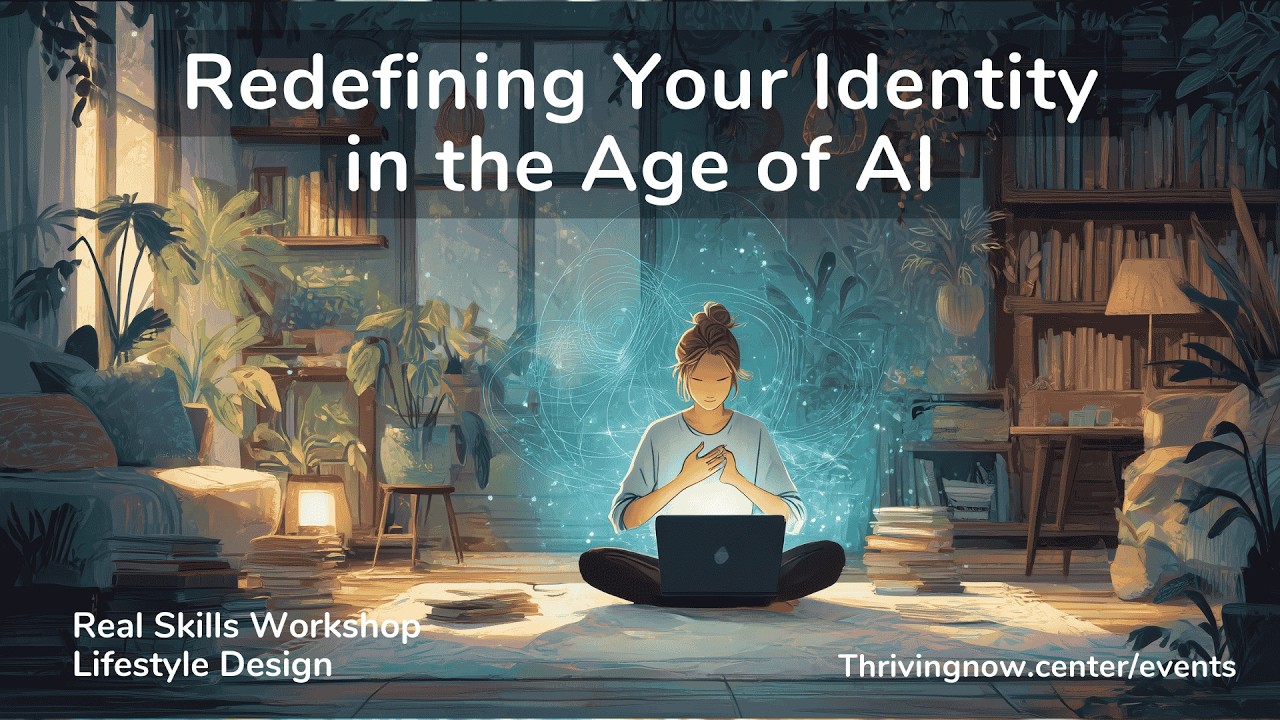
[00:44:45] And while I didn’t send this one out, there’s an image for this workshop. There’s been an image for every workshop that used to be that Cathy and I would really struggle with for
[00:44:57] Cathy: hours.
[00:44:57] Rick: I’m big stock photo.com to try to find a stock photo that fit. And today I say, Hey, this is this workshop I’m doing redefining your identity and the age of AI.
[00:45:13] Can you you know what ideas AI. Based upon what I’m telling you, I want to have I’m trying to find a identity. There we go.
[00:45:26] Okay. I am going to even share this.
[00:45:32] Cathy: I still remember, I would go through sometimes that was me going through big stock and I would send Rick three or five images and he is no. And I’d go back and spend another hour and send three to five images. Okay, let’s use that. And I think this is a very cool image.
[00:45:47] Rick: Yeah. And this image never existed before.
[00:45:50] Now this isn’t something that was pulled directly. As you can see, there’s a variety of different styles and everything else that are happening. There’s plants, there’s a glow, there’s a radiance and aura behind her that is interconnected. And it just, it feels really good. And they’re books, right? It’s not saying that there’s nothing about earthy existence.
[00:46:12] But this art was created, co-created by me and Midjourney, an AI tool to represent and in, and invite people. Now, the wording on it was put on by hand by me using a different tool that’s been around Canva. And why do I say this? I’ve always needed an image. No, there’s never been a time in Thriving Now’s history where I had enough to spend 100, 200, $300 for an artist to do an image.
[00:46:48] And one of the challenges with that is I’m a picky Ricky, and I could pay a really talented artist to do something, an original work that they just thought was absolutely amazing. And I’d be like, I can’t put that out there.
[00:47:03] Cathy: Not me.
[00:47:04] Rick: Not
[00:47:05] Cathy: me. I’ve had a lot of, I teach classes for in the Sex positive community for educators, and they’re like, no, they should hire virtual assistants.
[00:47:11] They shouldn’t use AI. And I’m like. Most of them are not making enough money to do, hire a virtual assistant. Maybe if they use AI, they can generate enough money that they could, but it’s not, oh, if I use AI, I’m gonna, if I’m turning out, I’m not hiring a virtual assistant. What’s happening is if they don’t hire, use AI, they’re just working more hours.
[00:47:31] They’re not, it’s not displacing people in that field because they’re not making, most of 'em are not making enough money to do it anyway. And I’d rather see them have some time to relax and enjoy themselves and still reach people and make a difference. So it’s not always displacing people.
[00:47:47] Rick: We, we took a whole series of measurements yesterday and just put them into an AI and say, could you summarize and make sense of this?
[00:47:56] And the insights that it pulled from, three months of recordings of it’s a health oriented subject. And in that three months of recordings, what we did are notes, just, this is this. The AI took, it gave a summary and the front page of that was so useful to the doctor.
[00:48:20] Because they didn’t have to see this huge range of measurements. What does this mean? Okay, they can use their intuition and look at it, but that’s very different than a summary that the person who took the notes recognizes as, yeah, that’s, that makes sense. That’s exactly what we’ve been seeing, but summarized and done in 30 seconds rather than hours of,
[00:48:45] Cathy: and probably with more precision and accuracy than a human.
[00:48:47] But human, AI looks for patterns beautifully. And my ability to rock patterns through 60 days or whatever days of data is humans get really skewed sometimes. We’re not always as accurate as we’d like to think we’re
[00:49:03] Rick: So for example if my identity says I am savvy
[00:49:07] Rather than I know things or, I’m in, I’m informed, like I’m an informed person.
[00:49:14] If I carry that in my identity and all of a sudden now I’m up agAInst an information source that is more current exposed to more data than even the largest office building in the country. If everyone was studying it and you’re like, okay, what does it mean to be, I am informed? Does that really feel good to me anymore?
[00:49:45] I’m curious and I know how to discern, so I am discerning, I’m savvy and I’m discerning. That’s an identity I can practice for the rest of my life. AI actually helps with that. From my standpoint,
[00:50:02] Cathy: I think you’re going a level deeper instead of I am an artist and I do, I am the person that does this.
[00:50:08] I am someone who creates and looks for beauty. And I think of it people get very fixated on this is my who I am, but we’re not the same person throughout our lives. We start off as a child and a teenager and an adult and then you know, someone who’s el more elderly. I noticed that the things I used to love doing, I thought I would do for the rest of my life.
[00:50:28] Like some of them I’m like, that was really fun and it was amazing experience and I don’t want to do that anymore. I wanna do something different. So I think the more we can hold onto the concepts of. The philosophy of how we wanna interact with the world, the creativity, the beauty, the expression, and less about how it’s got to be this way for me to be okay.
[00:50:49] Then we start having more fluidity, and that might let us dance across technical changes a lot more easily. I’m curious what you
[00:50:57] Rick: think, so when I’m working with someone who’s fundamentally faced with this there’s a what if you go deeper into the essence of what you do as a lawyer, let’s say what is your real role?
[00:51:12] I provide structure. I provide clarity. I provide opportunities for resolution without violence.
[00:51:21] Cathy: Good one.
[00:51:22] Rick: That’s a good one. Great. Now if that’s your. You’re like, oh, that’s what I do. Then the tools that you use can shift and change, and you bring yourself, your heartistry, I call it.
[00:51:36] And when you hear someone in your circle and they’re very stressed about it. Not everyone can go deeper, but if you know someone and you like them, chances are what do you do for a living is not how you actually interact with them.
[00:51:56] Notice that we lead with this question in a lot of settings.
[00:52:01] What do you do for a living? That really speaks to what I do for a living is my identity. This is a lot of
[00:52:09] Speaker 3: people. That’s true.
[00:52:09] Rick: What’s your name? Identity. What do you do for a living identity? Okay. If you, if we said. Hey, what’s your name? Rick. What matters to you these days? I just love that I get to be creative and co-creative and curious, and there’s so much less resistance.
[00:52:31] Now. There’s, it’s easier, faster to be in my flow in ways that, and that leaves me more space for family or even really feeling into what’s next for me in ways that when I was just pressured to do a lot of things that took a lot of hours. There’s so much more freedom possible.
[00:52:53] Cathy: If someone shared that the, a friend of theirs is no longer speaking to them because they’re using AI and the friend is feeling probably threatened because there’s someone who use AI is threatening their jobs to me. Everybody gets to choose who they speak to and whatever, but it’s, it seems like they’re holding onto this fantasy that if everyone just doesn’t use it, it’s gonna not happen.
[00:53:15] So you stop using it, you’re, you personally are threatening my job. And it’s no, this is, agAIn, it’s happening. It’s just getting woven into everything. And it’s like when we hold onto fantasy or delusion, then we can really hurt ourselves and others. It’s just no you’re threatening my job by using AI.
[00:53:32] It’s no, I’m using the tool that’s avAIlable in an ethical way. If you don’t wanna talk to me, you get to, but I’m not threatening your job because usually people don’t stop talking to you unless there’s some kind of offense of some kind of imagined or real. And so I’m guessing that maybe they feel offended that oh, you’re threatening my job.
[00:53:49] You’re taking my job away. It’s no, not really.
[00:53:53] Rick: Yeah. And this is part of the savvy reality. And I like tapping because it can acknowledge even though it hurts that this friend isn’t talking to me anymore,
[00:54:03] Cathy: even though it hurts that this friend is not talking to me anymore,
[00:54:07] Rick: it’s a yes for me to use AI.
[00:54:09] Cathy: It’s a yes for me to use AI.
[00:54:13] Rick: It’s revealing things.
[00:54:14] Cathy: It’s revealing things
[00:54:16] Rick: like my creativity,
[00:54:18] Cathy: like my creativity,
[00:54:20] Rick: And it’s a yes for me
[00:54:23] Cathy: and is a yes for me.
[00:54:25] Rick: And some people are gonna be terrified
[00:54:27] Cathy: and some people are gonna be terrified. Top
[00:54:30] Rick: of the Head:. I’ve lived long enough to see this.
[00:54:33] Cathy: I have lived long enough to see this
[00:54:35] Rick: Eyebrow:.
[00:54:36] People were terrified of the TV.
[00:54:39] Cathy: People were terrified of the tv.
[00:54:42] Rick: They were terrified of the internet.
[00:54:44] Cathy: They were terrified of the internet.
[00:54:46] Rick: They were terrified of cars and AIrplanes.
[00:54:49] Cathy: They were terrified of cars and AIrplanes.
[00:54:52] Rick: They were terrified by the printing press.
[00:54:55] Cathy: They were terrified of the printing press.
[00:54:57] Rick: They were terrified by so many things,
[00:55:00] Cathy: terrified by so many things.
[00:55:02] Rick: We do get terrified as humans.
[00:55:05] Cathy: We do get terrified as humans.
[00:55:08] Rick: That’s not my sweet spot.
[00:55:10] Cathy: That is not my sweet spot.
[00:55:13] Rick: That is not my sweet spot.
[00:55:15] Cathy: That is not my sweet spot. I, one thing that helps me when I need to reality check myself is back when trAIns were first, the late 18 hundreds trAIns were coming out and they’d not had trAIns before.
[00:55:28] Like people were not traveling that fast. SustAIned a race, a racehorse docking might go that fast for a minute, but no one had traveled that speed. And they had huge groups of people thinking that people’s organs would dissolve if people traveled at that speed for, like for any amount of time.
[00:55:47] And now we travel much faster than that. It’s not, but there’s, there is fear about change and the unknown, and that’s normal and it’s okay to be cautious, but to like they had a whole hypothesis of what was gonna happen with the trAIns going that fast and like women shouldn’t ride 'em 'cause it would, like their organs would drop out or something.
[00:56:04] There were all kinds of stories about it and there’s a lot of. Stories about this and I do think that a certAIn amount of regulation is useful. Like I don’t want deep fakes of me out there. If I can help it, I prefer that there were things like privacy and how are we using it in an ethical way?
[00:56:21] And I’d love to have more job education for people. I’d like to have people tra transition a little more smoothly. But I think there’s a lot of fear on top of whatever real concerns there are. There’s a lot of fear because it’s new and unknown and humans tend to froth a lot when we get new things.
[00:56:39] Rick: You notice when that tapping, I talked about the sweet spot. So if somebody’s in fear, their capacity to see the spectrum or find their sweet spot is really limited. That’s why so much of our work with ThrivingNow over the years has been, are you in your permitted brAIn? Yes. Let’s do some tapping.
[00:56:56] Very much sometimes back into a kind of capacity to be aware, capacity to adapt. Accept. A capacity to adapt, to take inspired action and to allow things to unfold too that are outside of our direct control
[00:57:15] Cathy: be with reality. To be with the actual, rather than the fears of what might happen in the hypothe hypotheticals is I can be aware of those, but what is actually happening right now?
[00:57:25] Rick: Yeah.
[00:57:25] Cathy: Like what am I, what, are people’s organs actually dropping outta their bodies? No, they’re not. Okay. Maybe it’s okay.
[00:57:31] Rick: And people that have done emotional freedom work on around things that we’ve had anxiety worries or fears about and have lived to see it unfold. It’s not that it’s black or white.
[00:57:43] Oh, it’s all great. It’s gonna destroy all of us. Yeah, there’s a spectrum of possibilities and the more of us that are in our awareness and solid. Responsiveness. Guess what? We’re crafting. We’re co-creating, we’re co-creating what works for us and what doesn’t.
[00:58:05] Cathy: Taking living
[00:58:06] Rick: action,
[00:58:07] Cathy: thoughtful living action.
[00:58:09] Rick: We will be hearing from a lot of people who have, as their identity to resist have as their identity to put their focus on a theoretical or a real issue.
[00:58:28] Speaker 3: Right.
[00:58:28] Rick: And make that, make it all about that. And that approach for me, Rick I need to be aware of the spectrum and define my sweet spot.
[00:58:40] Cathy: Yeah.
[00:58:40] Rick: Okay. And like there are people right now who are talking about AI. The same thing Cathy and I are talking about, and they would be saying if you’re not using AI for three hours a day for the things that matter to you, you are screwed. Two years from now, you’ll be unemployable. I see those messages.
[00:59:05] And I, anyone who’s that kind of exaggerator I block, like on social media, I just, I don’t need that. But I’m also aware that there are people whose fear and identity tap is being impacted by people who are saying, this is such a big deal that if you’re not doing this, then you’re gonna be lost.
[00:59:30] Speaker 3: Yeah.
[00:59:30] Rick: I think if I was in a place where I felt like, oh yeah. What people still want are a course, an online course that you can sign up for and go through it in a linear way. And at the end of it of all those modules you’re going to have this result. That’s the traditional online, if you’re a content creator, that used to be the model.
[00:59:55] Cathy: Yeah.
[00:59:56] Rick: We have a bunch of courses that are like that. I will say for myself that I’m not interested in that kind of delivery anymore. What I love,
[01:00:07] Cathy: the number of people that actually finished those courses was so small.
[01:00:10] Rick: I know. It was sad. But here I know that somebody came to, I don’t know who they were 'cause I only look at the anonymous ones.
[01:00:18] But someone asked a question and it pulled from. The sixth week of a course that we did, the q and A webinar that we did, and it gave the best answer. Like I was so proud of the work that we’ve done and the tuning I’ve done on the AI, that the answer that it came back with was so useful to my heart.
[01:00:50] Now I don’t know how they took it, but they continued on and went deeper and they were tapping into their issue wasn’t sleep at all, but it was pulling from sleep now, right? Like. All of it gets interwoven into a tapestry that is fresh
[01:01:11] Cathy: for that person. I think that’s beautiful. I want the information and so much what we talk about comes from a common core.
[01:01:16] We’re just looking at different aspects of it. It’s like I want people to get the wisdom from wherever it is. I don’t want them to have to wade through a hundred hours of information if they can get it in three. It’s what’s gonna impact your life?
[01:01:29] Yeah.
[01:01:29] Rick: So I would like to take a very short break here if any of you that are happen to be with us live.
[01:01:35] Thank you so much. If you have a question that you’d like Cathy and I to tend to please post it now during the break. We’ll break for seven minutes. Cathy, and I’ll come back and try to answer as many as possible. And if there are none, we’ll just wrap it up. I think that. That’s good.
[01:01:50] We’ve covered it a lot. And AI is gonna be with us and a part of our work in emotional freedom and freedom technologies for the rest of my life. And it’s exciting to me, as you can tell, and it opens up. I see people in my home things that could be incredibly stressful of writing and rewriting that are now just, they’re so appreciative that I introduce them to these AI tools and my 12-year-old will ask questions and get answers. And my 5-year-old is, commanding AIs to find songs, you’re
[01:02:30] Speaker 3: so cute.
[01:02:31] Rick: This is a song, ADA Boom di Oh yeah. That’s called, I love the mountAIns. Boom di here it is. Like she starts singing it. I like
[01:02:41] Cathy: all the hand motions and everything.
[01:02:43] Rick: So yeah, we’re gonna take a break and pause the recording and we’ll be back. Welcome back. Identity can be in our head, right?
[01:02:55] But it also, when we’re shifting our identity, it’s, that’s why you’ve sometimes seen me talk about, feel into my core. So I asked my AI during the break what would it want to make sure we covered? And it talked about the somatic experience. Oh, I’m a writer. Oh, AI can write what tension.
[01:03:19] Do you have, and as you go deeper what does it mean to me when I say I am a writer, which is a doorway into something? What does it actually, what’s going on when I’m in that I’m a writer mode.
[01:03:36] Speaker 3: Yeah.
[01:03:36] Rick: What’s my felt sense? Oh, I’m bringing forth, I’m bringing forth from a place inside me. Something that didn’t exist before.
[01:03:46] Yeah. I am, I’m feeling the prompt of my creativity and I’m bringing it out in a way that’s uniquely me.
[01:03:56] Cathy: Yeah.
[01:03:58] Rick: Oh.
[01:03:59] Cathy: I think that looking at, and also what is the intention of what we wanna, like, when I write, I wanna communicate. I wanna either create a feeling or an experience or a insight for somebody.
[01:04:09] And we can use AI and generate a lot of material really quickly. But part of when we write ourselves, or we use AI, it’s a curation. If I give someone 30 pages of stuff, they’re, unless they’re super interested and tuned in, they’re not reading it. But if I can give them a paragraph or a sentence that like, really touches them, then maybe they wanna read more.
[01:04:30] So there’s a curation process that is core to the intention of what I’m trying to create.
[01:04:36] Rick: Yeah. So if my, if I was with my younger self, my college self, it would be. It would be like, yeah, this is a shake in what it means to be smart, but hey, Ricky or Rick, at that point I had changed my name.
[01:04:57] I had changed my identity from Ricky to Rick. What what does it mean to you? And it’s I believe that he would’ve said, I use my mind to figure out ways to be efficient and effective.
[01:05:13] Speaker 3: Yeah.
[01:05:14] Rick: Without over grinding. Oh, Rick. Yeah. And here you are in college and they’re layering on this kind of, they make you grind through textbooks rather than having a good teacher
[01:05:29] To teach you. Oh yeah. Oh, you know what? There’s this this. 120 page PDF and you’ve always wanted to read it. It’s been sitting there in your inbox, read this about circling, right? And guess what hey, we’ve got this new tool and you upload this 120 page PDF and you say, Hey AI you’ve come to know what matters to me.
[01:05:55] I’ve talked about it, my concepts for thriving. As you look at this and what you know about circling as I talk about it, what, is there anything new or fresh about circling Yeah. In this document. And they can
[01:06:09] Cathy: function through so much faster than I can
[01:06:12] Rick: right now. Maybe if I had the author with me, I might ask that question, but then they would have to know me and they’d have to know their work and be able to put it into my terms.
[01:06:24] But I get back this thing and. I can then ask and go deeper. I have thousands of quotes that I have used read wise to collect from books, from my Kindle books. I’ll highlight things that matter to me. So I’m reading a book, I highlight things. And the reason I use Kindle is that can make the text bigger.
[01:06:45] 'cause I always have used glasses and I can highlight and I have a tool that takes those highlights and brings them back to me. Each day I get a reminder of certAIn highlights and I can now use AI to talk to those highlights and say, I’m exploring right now what feels like a savvy in a challenging situation.
[01:07:13] What are some things that I’ve. And it will bring forth those things without me having to do the curation. And this is, I do believe that body guidance can tell us when we’re taking a shortcut that diminishes us. For example, it’s not diminishing to me to not watch a two and a half hour podcast on a topic I’m interested in and click an AI and say, give me the key points here that apply to me and read those key points or skim them and say, oh, where do they talk about that?
[01:07:56] And jump into the video, watch three minutes out of hours and get what I want. Is that diminishing me? No, not
[01:08:04] Cathy: listening to it because it’s two hours and you’re not gonna get to it.
[01:08:06] Rick: I’m not gonna get it. But what would be diminishing is if I just ask the AI to summarize this workshop and I just copy paste it and didn’t read it before sending it out to the community, that’s different than
[01:08:18] Cathy: checking it over and going that doesn’t feel quite right.
[01:08:20] I need to tweak this.
[01:08:22] Rick: But what I do know is that I would not have the time to go back through these 90 minutes with Cathy and be able to summarize it as well as a tool that can actually listen and pick out based upon our intentions, what are the key points.
[01:08:39] Cathy: Much fun as it would be
[01:08:40] Rick: for the two to sit down
[01:08:41] Cathy: and do that.
[01:08:41] It doesn’t work.
[01:08:45] Rick: So these are things where if you use your body guidance, you’re like, oh, this is good for me, this is good for me. Oh yeah, this helps me do something that I don’t want to do or I’m not very good at. I used AI the other day to strip out. I had it, I. I was feeling emotional. I wrote something that had a lot of like emotion and mixed message and things, and I just, I got my body guidance that like, oh, this needs work.
[01:09:21] What I really want to communicate. This was good for me. I wrote it all out, vent it out. This is really good. I’ve expressed myself, that’s good, but I don’t actually want to send that. That is not use, that is not what I wanna do. So I’m, I copy paste it into an AI and I say, I would like this to be neutral, matter of fact, and civil.
[01:09:41] Cathy: Yes.
[01:09:42] Rick: And useful for this purpose. The draft, it came back, I changed one word.
[01:09:50] Cathy: Sometimes that happens, sometimes I have to go, no, that’s not it at all.
[01:09:54] Rick: Now, I know that Rick in certAIn modes can do that. I can take and do exactly what I asked, but having a tool that could do that, I could feel the body yes.
[01:10:04] Yeah, this is better. A better expression for me to put my name on top of than it would be if I had written the raw material. And when you land on something like that, to me, in my identity, it says I am savvy enough and aware enough that I can be rageful. And I can be over empathetic.
[01:10:27] I can be, I could, I’ve got a broad spectrum capability,
[01:10:35] Cathy: all the different things.
[01:10:36] Rick: It sometimes having a tool that’s yeah, I’m aware and I want to tune myself. Tapping does that. I’m aware, even though I am outraged by this, I’ve, I would really prefer to be absurdly calm and confident, right?
[01:10:54] Yeah. And if I said that to an AI, even though this is an expression of my outrage, I can you tweak this so it just sounds like I am ridiculously calm and confident. Now, if you like EFT tapping, if you like this idea, take something like that. Just write it out, beat it in, and see what comes back. You can even say that doesn’t sound like me.
[01:11:20] Can you at least take some of my, can you make it? Is there any way for you to make it sound more like me?
[01:11:27] Cathy: Yeah.
[01:11:28] Rick: And when you start playing with it like that, you can really embrace your co-creator. You’re co-creating with consciousness. You’re co-creating with the tools in your hand, the, and you’re expanding, you’re growing, you’re things that weren’t possible before.
[01:11:48] I know somebody that wrote a children’s story and then they fed the children’s story into Suno and turned it into a musical.
[01:11:59] Speaker 3: I love it.
[01:12:02] Rick: There’s 0% chance that she had the skill to do that.
[01:12:06] Speaker 3: Yeah.
[01:12:07] Rick: But it even sounds like her singing, because Suno now you can sing and it’ll be like, yeah, and please make this sound,
[01:12:16] Cathy: take out the pitchy
[01:12:17] Rick: stuff professional.
[01:12:19] A few sec, a few seconds of your singing and it can turn it into something. And did that take away somebody’s job? I. I don’t think those jobs existed for that particular purpose. You weren’t gonna hire someone to save, they weren’t gonna hire someone. But that to me is for those of us that have sought freedom to be as creative and co-creative and expressive as we want for ourselves, for the pleasure and joy of it, to have something that we share maybe with our future self.
[01:12:53] Look what we did five years ago, or with our kin, the people in our community. There are people that are drawing things by hand and also using AI that share it out on ThrivingNow Center. And I love that we have space for all of that.
[01:13:07] Cathy: Yeah.
[01:13:08] Rick: Thank you for co-creating, Cathy.
[01:13:10] Cathy: Oh, my pleasure. I love that you were talking about identity and this is really core to who I am.
[01:13:15] Am too is love that we got to dig in and get some good questions and comments. And we all have lots of ease with our using our life force to create amazing things.
[01:13:24] Rick: Our inbox is open support at ThrivingNow dot com and it’s a rick that reads that and Cathy so not
[01:13:31] Cathy: an AI,
[01:13:32] Rick: it’s not an AI at this point that reads those emAIls.
[01:13:35] We get just a select number. So if there’s something here that, speaks to you that you’d like us to continue to go deeper on please let us know.
[01:13:44] Cathy: Yeah,
[01:13:44] Rick: so
[01:13:45] Cathy: thanks everyone. Have a great day.
[01:13:47] Rick: Bye.
[01:13:49]
Great to have you on this journey with us!